
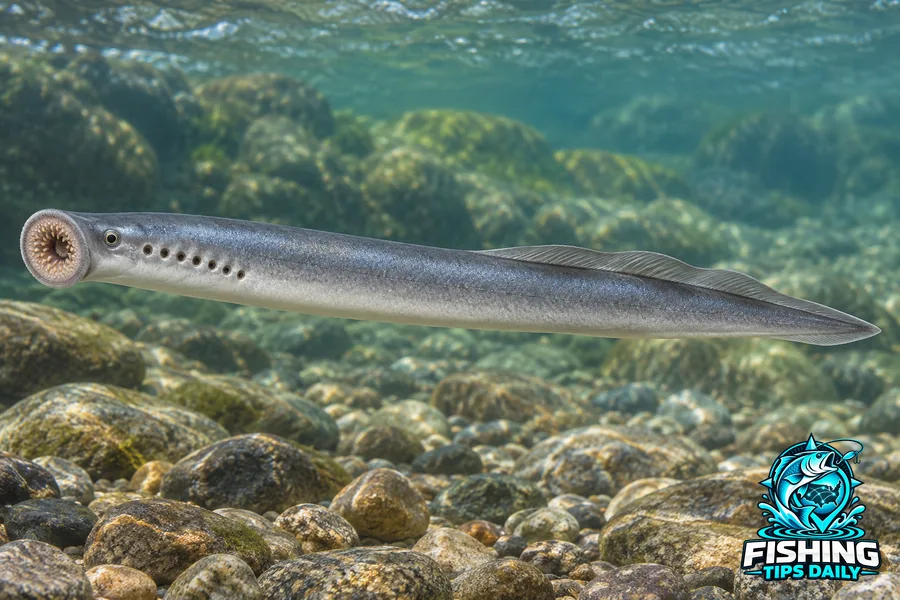
Range and Identity
Ichthyomyzon unicuspis occurs in northern and central North American drainage systems. Its single dorsal fin helps distinguish it from Sea Lamprey. The presence of a parasitic lamprey in a lake does not mean that the fish belongs to the introduced Sea Lamprey population.
Habitat and Behavior
Larvae live in sandy or muddy pools and backwaters. Feeding adults are commonly attached to fishes in large rivers, lakes and impoundments. These stages occupy different habitats, making life stage essential to a useful biological observation.
Food and Life History
The reported maximum is 39.2 centimeters total length. Adults move toward gravel riffles and runs for spawning and reproduce once. Regional larval and adult durations vary, so one locality’s seasonal timing should not be assigned to the entire range.
Field Note
Include a clear view of the dorsal fin and the drainage when identifying a lamprey. Distinguishing native species from Sea Lamprey is more useful than treating every attached lamprey as the same fish.
All Lakes With Silver Lamprey
Browse lakes and reservoirs with documented Silver Lamprey records, listed alphabetically. Records do not establish current abundance or public access. Check the evidence and managing authority for the water you choose.
Showing 1–18 of 18 lakes · Page 1 of 1
- Black Lake Cheboygan, MI
- Burt Lake Cheboygan, MI
- Crane Lake St. Louis, MN
- Crooked Lake Emmet, MI
- Lake Agnes St. Louis, MN
- Lake Erie Lake, OH
- Lake Huron Alcona, MI
- Lake Michigan Mason, IL
- Lake Michigan Lake, IN
- Lake of the Woods Lake of the Woods, MN
- Lake Saint Clair Wayne, MI
- Lake Superior Keweenaw, MI
- Little Vermilion Lake St. Louis, MN
- Namakan Lake St. Louis, MN
- Otter Lake Houghton, MI
- Rainy Lake Koochiching, MN
- Sand Point Lake St. Louis, MN
- Van Etten Lake Iosco, MI