
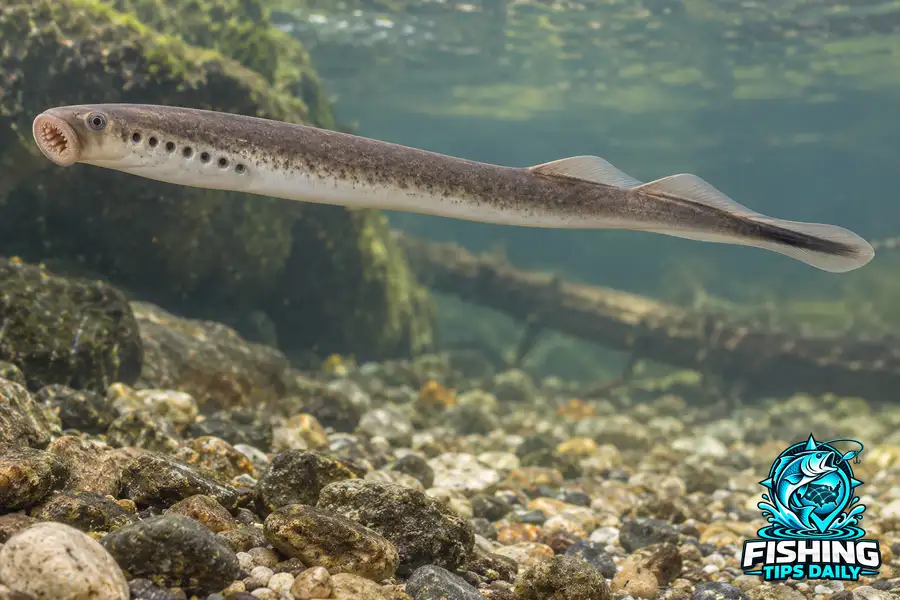
Name and Appearance
The name comes from discovery in the Friant-Kern Canal, not proof that the species occupies the Kern River basin. Its elongated body lacks paired fins and jaws. The adult oral disc has smaller, blunter teeth than those of predatory lampreys.
Larval Habitat
Larvae, called ammocoetes, bury in sand or mud and filter tiny organisms from the water. Shallow backwaters and slow stream edges provide suitable settings. Adults require coarser gravel and rubble, so fine sediment alone does not describe all life-stage needs.
Length and Life Stage
The agency account gives adult lengths of 81–139 millimeters total length and larval lengths reaching 142 millimeters. Larvae can be longer because nonparasitic lampreys shrink during metamorphosis. Keep the stage attached to a measurement instead of assuming the longest specimen must be an adult.
A Larger Lamprey May Be a Larva
Metamorphosis can reduce length in this nonparasitic species. Adult and larval measurements need separate labels to avoid a misleading comparison.
All Lakes With Kern Brook Lamprey
Browse lakes and reservoirs with documented Kern Brook Lamprey records, listed alphabetically. Records do not establish current abundance or public access. Check the evidence and managing authority for the water you choose.
No published lakes are currently linked to this species in our confirmed records.