Find their depth.
The lake may be 20 feet deep while the crappie are suspended halfway down. Put the bait where the fish are, not automatically on the bottom.
A little jig. A well-set float. That unmistakable tap. Learn how to find black and white crappie, keep your bait in front of them, and turn one good bite into a pattern.
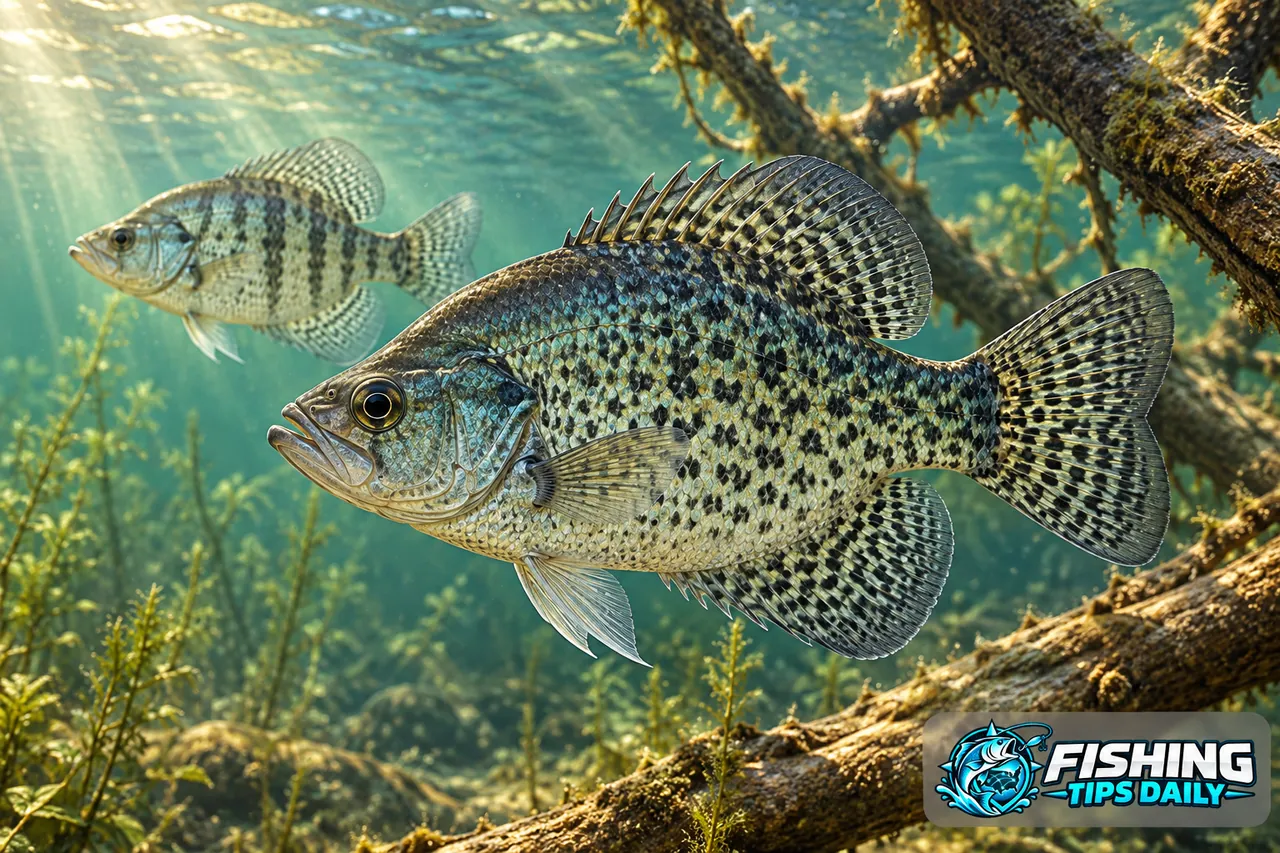
The lake may be 20 feet deep while the crappie are suspended halfway down. Put the bait where the fish are, not automatically on the bottom.
A twitch followed by a still bait is often worth trying before another hard jigging stroke. Watch for slack line as carefully as you watch for a pull.
Remember the countdown, float setting, casting angle, and retrieve. Make another cast through that same lane before changing tackle.
Both belong to the sunfish family, alongside bluegill and black bass. Their flattened bodies earn them the nickname “slabs,” and their small-fish diet makes a little minnow-shaped bait a useful place to start.
Pomoxis nigromaculatus

Pomoxis annularis

Start with something you can fish deliberately: a dock edge, a submerged branch, or a stretch of weedline. Work one depth at a time. If you keep changing color, distance, and sink time together, you won't know which change helped.
Use this chooser for a starting approach, then adjust to the fish and the local conditions.
Crappie often group up, but the entire lake doesn't fish at the same depth. One creek arm may hold shallow fish while the main lake has suspended schools. Break the water into manageable pieces instead of trying every good-looking bank.
A crappie's upturned mouth makes a bait overhead easy to intercept. Don't turn this into a rule that they never feed down; simply avoid dropping past a school before giving it a chance to bite.
Test the outside limbs first. A fish can sit above the top of the brush, so feel for depth rather than treating every snag as proof you reached the right spot.
Cast along the shadow line or lower a bait beside a permitted pier. Try the deeper outside supports as well as the shaded corners.
Follow the clear lanes beside healthy plants. A shallow float keeps the bait above vegetation instead of pulling it into the stems.
Use a depth change as a search route, then look for forage. Suspended crappie may be away from visible cover; sonar can help locate their level.
A Southern reservoir can be well into spawning while a northern lake is still cold. Read the warming or cooling trend, water level, and available food instead of choosing a depth from the month alone.
Before the spawn, check nearby breaks and routes into protected coves. As fish move in, try a jig beneath a float beside shallow wood or vegetation.
After a cold frontTest the next deeper edge and reduce the amount of movement. Fish can remain close to a spawning area without staying right against the bank.
Investigate shaded docks, brush, and suspended fish near forage. A vertical jig makes it easier to repeat a productive depth from a boat.
Don't chase depth aloneDeep water without adequate oxygen is no refuge. When the lake stratifies, fish may hold above the deepest water you can see on the screen.
A small paddletail or curly-tail jig lets you check creek arms and the edges of feeding areas. Count it down, swim it slowly, and note where it gets touched.
When you connectRepeat the cast, then probe the surrounding water. One biting fish can reveal a narrow travel lane rather than a whole productive cove.
Fish channel turns, deeper cover, or suspended schools with a small jig held nearly still. A subtle lift can be enough to show it to a nearby fish.
Through the iceCrappie can suspend well off bottom. Search the water column, follow local ice-safety guidance, and never assume ice is safe from a date or air temperature.
Low light is a useful starting window, particularly in warm water. Midday fish can still bite around shade or at a comfortable suspended depth. During cold periods, a mild afternoon may be more productive than first light.
Males prepare nesting areas in protected water and guard the eggs and newly hatched young. Females visit to deposit eggs; the whole population does not spawn on the same afternoon or at the same depth.
Some fish are arriving, some are nesting, and others have already moved out. If a shallow pocket goes quiet, follow its first break toward deeper cover before leaving the area.
A busy spawning bank is not an unlimited supply. Follow the water's harvest rules, handle released fish promptly, and move along rather than repeatedly working an obvious nest.
Depth, fall speed, and bait size are usually better first adjustments than buying another bag of colors. These six options cover very different presentations.

A hollow body with a fluttering skirt. Drop it beside wood, or suspend it beneath a float and let tiny movements do the work.

A slim soft plastic is useful when you want a quiet profile. Hold it above brush or give it short glides with generous pauses.

The tail moves on a steady retrieve, helping you search a stretch of bank or the outside of cover.

A compact swimming bait offers a little more movement for active fish. Count it down before retrieving through the school.

The dressing moves with very little rod input. It is a useful option when cold water or fishing pressure calls for a patient presentation.

Where bait rules allow it, a lively minnow under a float gives fish a natural target. Keep bait cool and oxygenated.
A 1/32- to 1/16-ounce jig is a useful light-tackle starting range. More wind, current, or depth may call for 1/8 ounce or more. Use the lightest head you can control; a bait you cannot keep at the intended depth is not helping.
Start with a natural shad shade, a dark silhouette, and a bright contrast such as chartreuse. Try a different color after you have checked depth and speed. Water clarity and light can change how the same bait looks.
 View larger setup ↗
Move the float to change depth. Choose a float sensitive enough to show a sideways slide or a lift.
 View larger setup ↗
Keep the shot above the bait and adjust its spacing to avoid tangles. Use a bead that cannot pass through the float opening.
 View larger setup ↗
Keep a slight connection to the jig. If the line suddenly goes slack before it should, a fish may have lifted the bait.
A light spinning outfit casts small baits, shows subtle takes, and cushions a hooked fish. Use a smooth lift to set the hook rather than a hard bass-style snap.
| Item | Starting choice | Why it helps |
|---|---|---|
| Rod | 6–7 ft, light power | Easy casting and enough give for small hooks. |
| Reel | Small spinning reel | A smooth drag protects light line. |
| Line | 4–6 lb monofilament | A manageable starting point for open water; step up around rough cover. |
| Extras | Small floats, jigheads, pliers, landing net | Depth control and gentle handling matter more than a crowded tackle bag. |
Match line and lure weight to the rod's rating. Long jig poles and trolling outfits serve other jobs; they aren't required for a first trip.
Pick a legal access point that reaches more than one depth. Fan a jig across open lanes, giving each cast a consistent sink time. If you get a bite, repeat that count and retrieve before trying a new direction.
When the best cover is shallow, switch to a float so the bait stays in place longer. Walk quietly, leave room for other anglers, and don't assume a dock or shoreline is public just because you can see it.
Boat position comes before lure choice. Keep the bait beside the cover without constantly dragging it away. Wind can create a big belly in the line, making a jig fish shallower than you expect.
Use sonar to find cover and suspended fish if you have it. Without electronics, a float and repeatable line length still help control depth. Work a manageable stretch carefully instead of drifting across the entire lake.
These methods help cover open water once you have an idea of the fish's depth. Start with a simple spread, keep turns wide, and track how speed changes the running depth of your baits.
Multiple rods and hooks have water-specific restrictions. Set up within those rules and give stationary anglers plenty of room. More lines are not an advantage if they spend the trip tangled.
A low, controlled cast can place a small jig along shade without moving the boat right over the fish. Start outside, then try a little farther into the shadow if access is permitted.
Dock shooting is a more specialized technique that stores energy in a bent rod. Beginners can reach plenty of fish with an underhand pitch; keep hooks clear of hands, faces, boats, and bystanders.
Check a different depth or the next piece of cover. A perfectly presented lure cannot catch a school that isn't there.
Pause longer or downsize. Try removing motion before adding more of it.
Repeat the successful lane, then look just to either side. The school may have shifted a short distance.
Ten places we'd put on a crappie trip list. These are our featured picks, not a live catch forecast. Start with the water's current conditions, access, and fishing rules.
A north Mississippi flood-control reservoir with a strong crappie reputation. Its changing water level makes the current shoreline more useful than last season’s bank.
Trip approach: Check creek approaches and available cover at the present lake level; plan for open-water wind.
Explore this water →Seasonal drawdowns reshape this Mississippi reservoir. The main lake and the separate Lower Lake below the dam should not be treated as one fishing area.
Trip approach: Pick a launch for the main reservoir, then test creek mouths and suspended fish rather than only shoreline cover.
Explore this water →Standing timber and numerous bridges give crappie anglers plenty to investigate on this East Texas reservoir. It is much more than a bass destination.
Trip approach: Probe timber and bridge cover at several depths. Check the special winter crappie rules before you fish.
Browse Texas waters →Another north Mississippi flood-control lake on our shortlist. Treat its changing water level as part of the fishing plan rather than background information.
Trip approach: Compare sheltered areas with nearby deeper approaches; check the current ramp situation before towing out.
Explore this water →Cypress trees, stumps, and submerged wood give this shallow Tennessee lake its unmistakable character. Crappie are one of its signature fisheries.
Trip approach: Fish the edges of wood carefully, and travel cautiously around submerged obstacles.
Explore this water →A large Tennessee River impoundment with water in Kentucky and Tennessee. The northern end around Gilbertsville offers a starting base for this big-water trip.
Trip approach: Break the lake into one bay and its deeper approach. Confirm the rules for the state waters you actually fish.
Explore this water →This Coosa River reservoir has a long-established crappie identity. Black and white crappie, along with naturally occurring hybrids, are part of the fishery.
Trip approach: Use creek channels and adjacent cover to organize your search; check the lake-specific crappie restrictions.
Explore this water →This pick is a river system, including the Lake Monroe area at Sanford. Florida anglers often call black crappie “specks” or “speckled perch.”
Trip approach: Consider open-water schools in the connected lake areas as well as sheltered edges; account for wind and river conditions.
Browse Florida waters →Oklahoma’s Eufaula has an established crappie fishery and maintained fish attractors. This is the Oklahoma lake, not the Alabama–Georgia reservoir with the same nickname.
Trip approach: Choose one arm or access area first. Investigate brush and attractors, adjusting to water clarity.
Explore this water →Also known as Bayou D’Arbonne Lake, this north Louisiana destination has crappie harvest rules designed specifically for its fishery. Locally, you may hear crappie called “white perch.”
Trip approach: Use channel edges and nearby cover as search routes, and check the current rules for larger crappie.
Explore this water →Choose for your kind of trip, rather than treating this list as a ranking. The reasons below are our interpretation of the linked agency information. Source checks: October 6, 2026.
Historical records and seasonal guidance do not predict today’s bite. Verify your access point, weather and current rules before departure.
Your shortlist is saved in this browser only.
| Water | Why consider it? | Access planning | Before you go | Source | Shortlist |
|---|---|---|---|---|---|
| Grenada LakeMississippi | Consider it when comparing Mississippi crappie destinations: Grenada appears prominently in the 2024 tournament records. | Choose your ramp after checking the lake project information. | Past tournament catches do not predict your trip. | MDWFP 2024 Crappie Tournament SummaryUSACE Vicksburg recreation directory | |
| Sardis LakeMississippi | Another documented Mississippi tournament destination to compare with Grenada and Enid. | Confirm your access point through the lake project. | Compare evidence periods and event formats before drawing conclusions. | MDWFP 2024 Crappie Tournament SummaryUSACE Vicksburg recreation directory | |
| Lake ForkTexas | A useful option for anglers who want to investigate timber and bridge cover. | TPWD lists public access facilities and a separate set of private facilities. | Submerged timber requires care when navigating. | TPWD Lake Fork fishing guideTPWD Lake Fork public access | |
| Enid LakeMississippi | Include it in a north Mississippi comparison rather than choosing a lake solely from its reputation. | Check the project directory before selecting a launch. | The 2024 report is historical tournament evidence. | MDWFP 2024 Crappie Tournament SummaryUSACE Vicksburg recreation directory | |
| Reelfoot LakeTennessee | Consider it for a shallow-water trip around wood and cypress habitat. | TWRA describes limited bank access, particularly in the middle basins. | Stumps, wind and seasonal refuge closures affect trip planning. | TWRA Reelfoot Lake fishing opportunities | |
| Kentucky LakeKentucky | An option for anglers planning a late-winter or early-spring crappie trip. | Use Kentucky Fish and Wildlife’s access directory to pick a named site. | Match your fishing location to the correct state’s rules. | KDFWR 2026 fishing forecastKDFWR Find a Place to Fish | |
| Weiss LakeAlabama | An Alabama crappie destination with both public facilities and private marinas to consider. | Outdoor Alabama identifies public access areas and private marinas. | Public and private facilities can have different fees and conditions. | Outdoor Alabama Weiss Lake | |
| St. Johns / Lake MonroeFlorida | For the St. Johns pick, focus the comparison on Lake Monroe at Sanford. | FWC names access near I-4/17-92, Enterprise Road and downtown Sanford. | This evidence concerns Lake Monroe, not the entire St. Johns River. | FWC Lake Monroe guide | |
| Lake Eufaula, OklahomaOklahoma | A crappie destination with agency-provided fishing information and attractor resources. | Use ODWC’s water page and linked maps to investigate your planned area. | This is Oklahoma’s Eufaula, not the Alabama–Georgia reservoir. | ODWC Eufaula water guide | |
| Lake D’ArbonneLouisiana | A practical option when you want a named park with fishing piers and a boat launch. | Louisiana State Parks describes fishing piers and a launch at Lake D’Arbonne State Park. | Park facilities do not establish public access around the whole lake. | Louisiana State Parks Lake D’Arbonne |
No waters are saved yet. Choose “All ten destinations” and select the waters you want to compare.
These are the ten destinations featured in this guide. This comparison adds agency evidence and practical planning differences; it is not a nationwide survey or a promise of fishing quality. Undated agency pages are labeled as such. A source check is not an on-site facility inspection.
MDWFP 2024 Crappie Tournament Summary: Reported events included Grenada, Sardis and Enid. 2024 tournaments. Tournament results reflect selected catches and different event formats, not typical catches or a universal best-lake ranking.
USACE Vicksburg recreation directory: The directory connects visitors to the Mississippi lake projects. Undated directory. Follow the lake project links to confirm access and conditions; this directory does not verify that an individual ramp is open.
TPWD Lake Fork fishing guide: TPWD lists black and white crappie and discusses timber, bridges and boating hazards. . This source is not a live catch or facility-status report.
TPWD Lake Fork public access: Use the named public facilities to plan a launch. Undated facility directory. Confirm current ramp status and fees before departure.
MDWFP 2024 Crappie Tournament Summary: Reported events included Grenada, Sardis and Enid. 2024 tournaments. Tournament results reflect selected catches and different event formats, not typical catches or a universal best-lake ranking.
USACE Vicksburg recreation directory: The directory connects visitors to the Mississippi lake projects. Undated directory. Follow the lake project links to confirm access and conditions; this directory does not verify that an individual ramp is open.
TWRA Reelfoot Lake fishing opportunities: TWRA describes crappie, shallow stump fields, limited bank access and refuge closures. Undated water guide. Check current rules and refuge notices. The page contains inconsistent crappie bag-limit statements; no numeric limit is repeated here.
KDFWR 2026 fishing forecast: The forecast discusses late-winter crappie at Kentucky and Barkley lakes. 2026 forecast, informed by 2025 surveys and other records. A regional forecast is not a current bite report.
KDFWR Find a Place to Fish: Links to the state fishing and boating access directory. Undated access directory. Confirm your exact site and state; not every shoreline is public.
Outdoor Alabama Weiss Lake: The state water guide describes the fishery and public and private access. Undated water guide. Confirm the selected facility and lake-specific rules before a trip.
FWC Lake Monroe guide: FWC lists black crappie and describes access around Lake Monroe. Undated water guide. Quarterly fishing suggestions are not a guarantee of current catches. Confirm access status.
ODWC Eufaula water guide: ODWC identifies Eufaula as a crappie fishery and provides planning resources. Undated water guide. Check current water-specific rules; no bag limit is copied into this comparison.
Louisiana State Parks Lake D’Arbonne: The park page describes crappie fishing, piers and a boat launch. Undated park page. Verify current park notices, fees and fishery rules before departure.
Destination: ____________________ Date: ____________________
Neither wins every day. Minnows offer natural movement and scent where live bait is permitted. Jigs are quick to cast, easy to change, and useful for searching. A float rig makes either one easier to hold at a repeatable depth.
Fish at the level of the school, not at a fixed “crappie depth.” Begin around the cover or forage you can locate and work the water column in steps. The important measurement is your bait's depth, which may be much shallower than the bottom.
It may be a light tap, added weight, a float sliding sideways, or line going slack as a fish lifts the bait. Reel into contact and lift smoothly. A violent strike can tear a small hook free.
Yes. Accessible piers, bridge approaches where fishing is allowed, and banks reaching cover or a depth change are useful places to learn. A float sets a repeatable depth, and counting a jig down helps you search beyond it.
No. A small bait is a convenient starting point, especially with hesitant fish. Active crappie feeding on larger forage may take a bigger profile. Make the size change deliberately and compare it at the same depth.
There is no single nationwide limit. Size limits, daily bags, rod counts, bait rules, and seasonal exceptions vary by state and water. Check the current rules for your exact destination before fishing, and check local consumption advisories before planning a meal.