
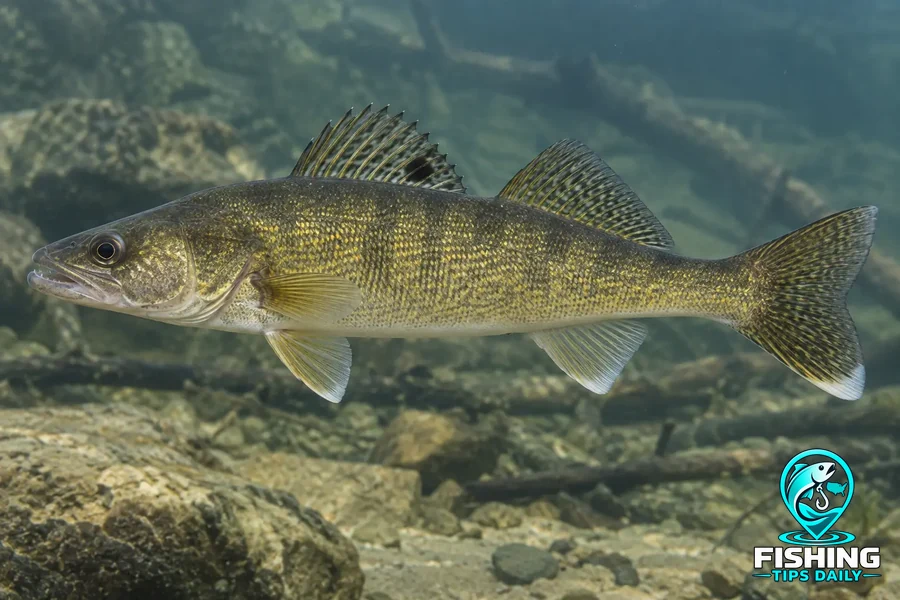
Range and Identity
Sander vitreus is the retained scientific identity. North American native populations and introductions outside that range should remain distinct. The pale lower tail tip is useful alongside other features, but a single marking should not replace a complete identification where similar fishes occur.
Habitat and Behavior
Walleye occupy freshwater lakes and rivers. Their feeding opportunities vary with water clarity, season and the availability of prey. A fixed rule that they feed only during darkness would be too narrow; the actual light and habitat conditions are useful details to retain with observations.
Food and Life History
Young fish consume small invertebrates, while fishes become prominent in the adult diet. Early spring spawning releases eggs over riffles or rocky shoreline habitat, without a guarded nest. The compiled maximum length uses fork length, unlike total-length measurements often reported for ordinary catches.
Field Note
Keep length convention and locality with a catch record. Published maximum length and weight are separate reference values and should not be described as a newly verified world-record fish.
All Lakes With Walleye
Browse lakes and reservoirs with documented Walleye records, listed alphabetically. Records do not establish current abundance or public access. Check the evidence and managing authority for the water you choose.
Showing 1–24 of 5,904 lakes · Page 1 of 246
- 144 Reservoir Dodge, WI
- Abiquiu Reservoir Rio Arriba, NM
- Abraham Lake Marshall, SD
- Acme Lake Westmoreland, PA
- Acorn Lake Becker, MN
- Acorn Lake Becker, MN
- Ada Hayden Heritage Park Lake Story, IA
- Adams Lake Lake, MN
- Adobe Creek Reservoir Bent, CO
- Adventure Lake Lake, MN
- Aerie Lake St. Louis, MN
- Agassa Lake St. Louis, MN
- Agate Lake Cass, MN
- Agate Lake Crow Wing, MN
- Aitkin Lake Aitkin, MN
- Albert Lake Wright, MN
- Albert Lea Lake Freeborn, MN
- Alberts Lake Marshall, SD
- Alcova Reservoir Natrona, WY
- Alden Lake St. Louis, MN
- Alder Lake Cook, MN
- Alder Lake Vilas, WI
- Aldridge Lake Oneida, WI
- Alexander Lake Lincoln, WI