
Identification
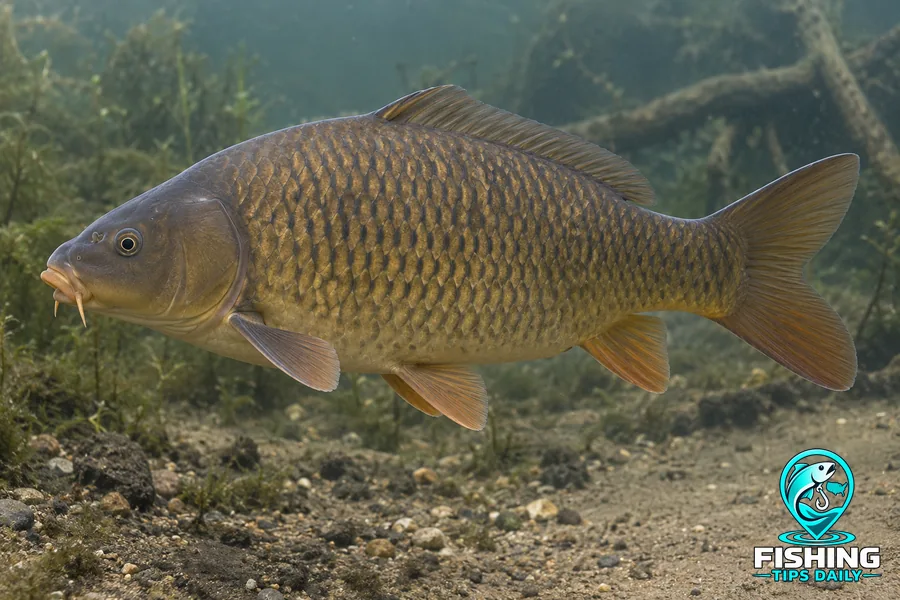
The body is heavy and usually brassy, olive or golden brown, with a paler belly. Barbels lie beside the mouth, and the long dorsal fin includes a strong toothed spine. Scale patterns vary, including forms with reduced or irregular scaling, so a sparse-scaled carp is not automatically another species.
Habitat and Feeding
Carp occupy still and slow-moving waters and tolerate a broad range of conditions. They eat bottom-dwelling invertebrates and plant material, rooting through sediment while feeding. Shallow margins can reveal their presence through disturbed mud or visible fish moving close to the bottom.
Fishing and Spawning
A bottom presentation near an active feeding area is a sensible starting point. Keep the line and rig suited to a powerful fish and nearby cover. Spawning occurs in shallow vegetated habitat, where adhesive eggs attach to submerged material. The published maximums are reference values, not claims about current world records.
Maximum Is Not Typical
Most carp are far smaller than the largest published fish. Local size expectations are more useful for tackle selection than treating an 88-pound reference as an ordinary catch.
All Lakes With Common Carp
Browse lakes and reservoirs with documented Common Carp records, listed alphabetically. Records do not establish current abundance or public access. Check the evidence and managing authority for the water you choose.
Showing 1–24 of 10,940 lakes · Page 1 of 456
- 28 Tank Yavapai, AZ
- 4-B Farms Reservoir Marion, OR
- A L Chaffin Dam Butte, CA
- A One Lake Apache, AZ
- A W Dale Lake Montgomery, AL
- A. J. Jolly Lake Campbell, KY
- Aarons Lake Columbia, OR
- Abbott Lake Sutter, CA
- Abbott Lakes Monterey, CA
- Abbott Pond Northeastern Connecticut, CT
- Abbott Reservoir Lassen, CA
- Abbotts Lagoon Marin, CA
- Abel Lake Cleburne, AL
- Aberdeen Lake Monroe, MS
- Abiquiu Reservoir Rio Arriba, NM
- Abraham Lake Marshall, SD
- Abramson Lake Lauderdale, AL
- Acherman Pond Dale, AL
- Achunachi Lake DeKalb, AL
- Acme Lake Westmoreland, PA
- Acme Pond Northeastern Connecticut, CT
- Acock Pond (historical) Houston, AL
- Acorn Lake Becker, MN
- Acorn Lake Becker, MN