Bass feeding in an open pocket
Cast a popper beyond the activity and work it into the pocket with short pulls. Leave pauses that let a following fish catch up.

Watch the surface—but wait to feel the fish.
See practical examples ↓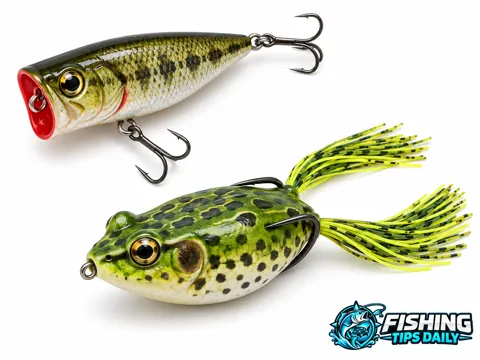
These are starting situations to try, not reports of a guaranteed bite.
Cast a popper beyond the activity and work it into the pocket with short pulls. Leave pauses that let a following fish catch up.
Use a walking bait to cover the edge while maintaining its side-to-side action. Keep a clear space behind you for its exposed hooks.
Bring a suitable frog to the opening and pause. Plan where the hooked fish can be led before making repeated casts into the thickest cover.
Presentation sketch · not to scale
A popper pushes water with a cupped face. A walking bait glides from side to side under a controlled rhythm. A hollow-body frog protects its hooks close to the body and can cross vegetation that catches exposed trebles. Those differences matter more than simply buying something marked “topwater.”
Use an open-water plug where the hooks have a clear route. Choose a suitable frog around surface vegetation, while recognizing that dense cover also demands appropriate line, rod power, and a realistic landing plan.
Short rod-tip movements and controlled slack let many walking baits turn instead of being pulled straight forward. Practice close enough to see the result. Large sweeps and tight line often drag the lure rather than letting it glide.
Poppers need a different pace: a small pull, then a pause long enough to see what happens. Change the pause before deciding every cast needs more splash.
Work a hollow-body frog across a suitable mat and pause at openings. A fish must locate and take the lure through the cover, so racing past every pocket wastes useful opportunities. Squeeze out accumulated water as the manufacturer recommends.
The frog’s protected hook arrangement also changes the hookup. Keep the bait straight, inspect its body, and use tackle suited to driving the hooks and moving the fish through the cover.
Early and late periods often suit surface presentations, but shade, cloud, forage activity, and cover can create other chances. Watch what the fish and bait are doing. If activity moves down, a subsurface lure may simply fit better.
Lures made to work on the surface. Open-water plugs and weedless hollow-body frogs have different jobs.
Make one deliberate adjustment at a time so you know what changed.
Allow controlled slack and shorten the rod movements.
Slow the response and inspect hook condition or frog alignment. Consider a follow-up subsurface bait.
Change hook arrangement or work a clearer edge.
Check the rules for your exact water before choosing bait, hooks, or a fishing method.