
Drift Fishing with Bait
Drift fishing allows water or controlled boat movement to carry bait across a target area. Success depends on a repeatable path and speed rather than letting the rig travel without observation.
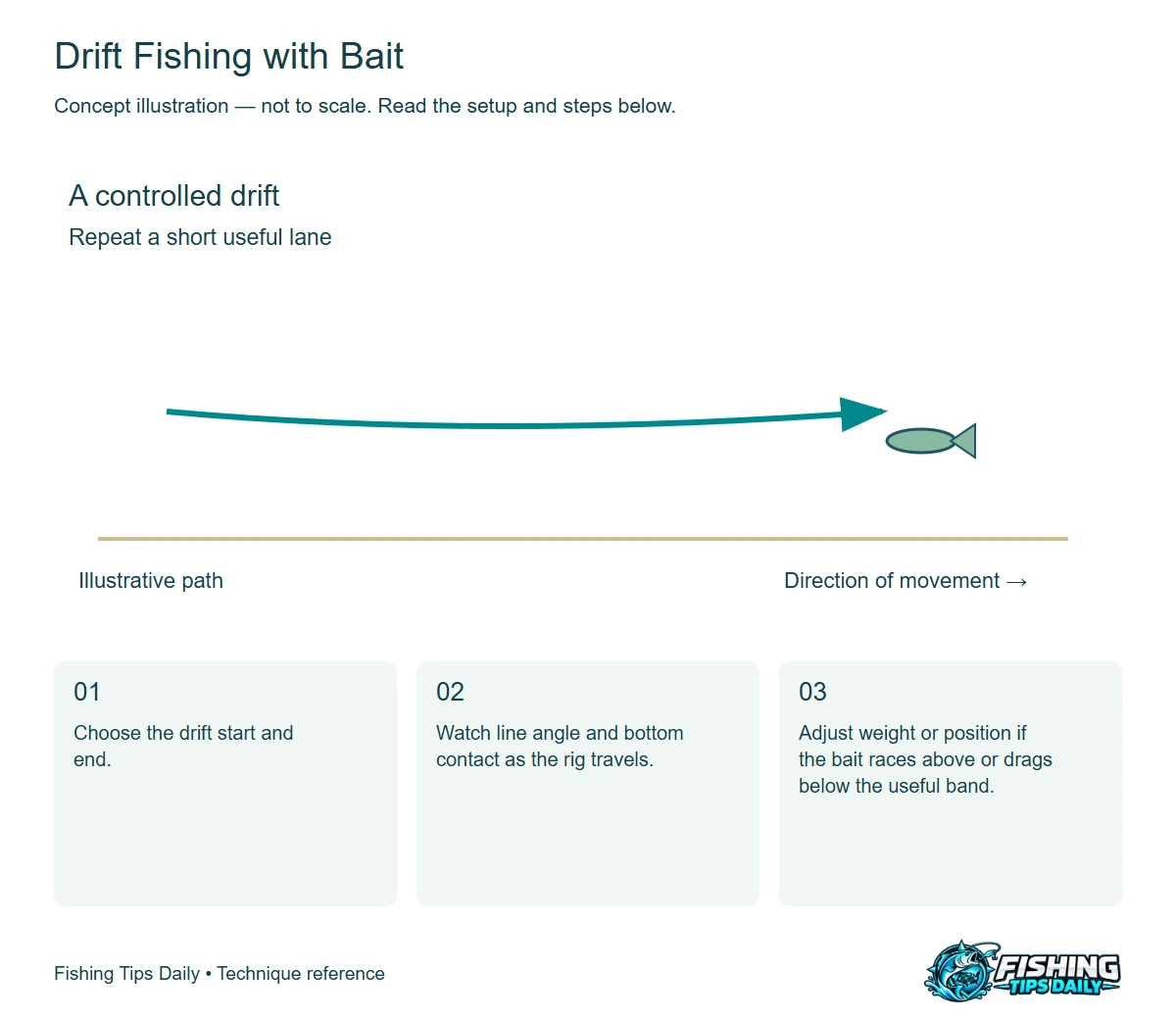
Build a setup that does the job.
Choose a rig that reaches the zone without constant wedging. Boat anglers need safe drift control and a return route. Shore anglers should keep the full drift within a controllable line angle.
Make the first test close enough to observe. Check the connection, the hook opening, and whether the offering follows the intended path. Correct a fouled or poorly balanced setup before adding distance.
How to fish it, step by step.
- Choose the drift start and end.
- Deploy the bait under control.
- Watch line angle and bottom contact as the rig travels.
- Adjust weight or position if the bait races above or drags below the useful band.
- Retrieve and repeat the productive path rather than extending into unknown obstacles.
A useful first test.
Across a clean walleye flat, repeat a short drift and note where contact occurred. A longer drift is not better if it carries the bait away from that depth.
Keep the productive detail repeatable: position, depth, speed, or pause. Change one of those at a time so you can tell what improved the presentation.
Variations—and what changes.
Boat drifting, bank drifts, and backtrolling differ in control. Backtrolling uses powered boat positioning and requires equipment and operator skill suited to the conditions.
Read the symptom before changing everything.
Repeated snags
Lighten the contact or change the drift lane.
Bait stays far behind
Check speed and line bow before adding weight.
Know when to change methods.
If the offering cannot reach the target, repeatedly snags, or demands equipment you cannot control comfortably, choose another presentation from this family. Keep the location clue you learned; changing a rig does not require starting the whole search over.
Use tackle and bait permitted on the water, and plan safe access and fish handling. The illustrations explain concepts; they do not replace equipment instructions or current local rules.