
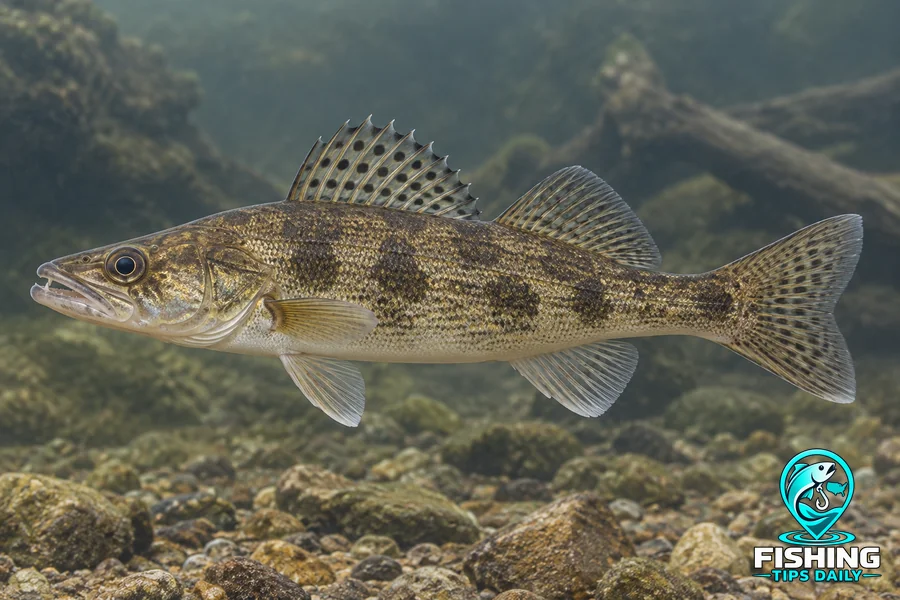
Range and Identity
Sander canadensis is distinct from Walleye and from their hybrid, Saugeye. Native records span major northern and central drainage regions, with introductions elsewhere. A stocked population should retain its introduction history rather than being used to redraw the native range.
Habitat and Behavior
Adults use sand and gravel runs, muddy or sandy pools and backwaters in rivers of different sizes. Lakes and impoundments also appear in records, although less frequently in the compiled account. This range of habitats is broader than a single description of deep lake water.
Food and Life History
Upper references are seventy-six centimeters total length and four kilograms. Larvae consume cladocerans, copepods and midge larvae, while juveniles take fishes. Spawning takes place in pairs or small groups, with the seasonal timing varying geographically.
Field Note
Keep Sauger and Saugeye measurements separate. A hybrid catch is useful information, but it cannot establish the maximum size of either parent species.
All Lakes With Sauger
Browse lakes and reservoirs with documented Sauger records, listed alphabetically. Records do not establish current abundance or public access. Check the evidence and managing authority for the water you choose.
Showing 1–24 of 134 lakes · Page 1 of 6
- Albemarle Lake East Carroll, LA
- Banner Creek Reservoir Jackson, KS
- Beaver Lake St. Clair, IL
- Big Lake Allamakee, IA
- Big Slough Allamakee, IA
- Bighorn Lake Big Horn, MT
- Boysen Reservoir Fremont, WY
- Bull Shoals Lake Boone, AR
- Butler Lake Allamakee, IA
- Carlyle Lake Clinton, IL
- Cheatham Lake Cheatham, TN
- Cherokee Lake Hawkins, TN
- Chickamauga Reservoir Hamilton, TN
- Chotard Lake East Carroll, LA
- Clinton Lake Douglas, KS
- Cordell Hull Lake Smith, TN
- Crane Lake St. Louis, MN
- Crooked Lake Anoka, MN
- Crooked Lake St. Louis, MN
- Crystal Lake Dakota, MN
- Dallas Lake Meigs, TN
- Desoto Lake Phillips, AR
- DeSoto Lake Pottawattamie, IA
- Douglas Lake Jefferson, TN