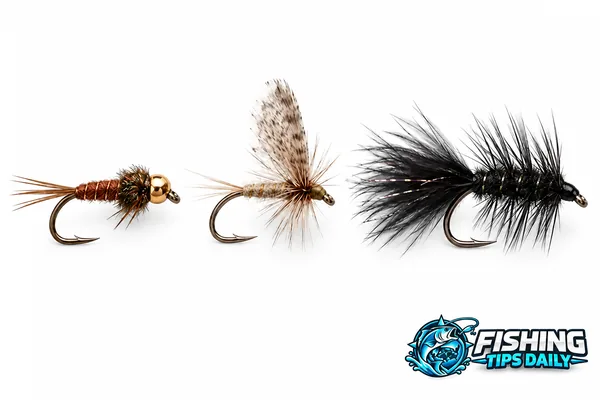
Dry flies, nymphs, and streamers
A dry fly is intended to ride on or in the surface film. A nymph represents underwater insect life and is fished below the surface. A streamer suggests a swimming food item such as a small fish. These are useful families rather than a rule that every pattern represents one exact animal.
Start by looking for feeding clues. Repeated surface rises suggest an opportunity for a dry fly. With no visible surface activity, a nymph or streamer may reach fish that a floating pattern passes over.
A drift can matter more than a perfect imitation
For a natural drift, the fly should move with the current instead of being pulled unnaturally by faster or slower line. Cast position, slack management, and mending help control that relationship. Mend deliberately without jerking the fly away from the fish.
Watch the currents between you and the target. Crossing several speeds with a long cast can make a believable drift difficult. A shorter cast from a better position often teaches more than another distant presentation.
Streamers add movement
A streamer can be retrieved in a lake, swung across current, or worked with strips and pauses. Size and weight should suit the rod, leader, casting space, and target fish. Heavy or large flies require controlled casting and enough separation from people nearby.
Try a short strip followed by a pause, then watch how the fly behaves. Some materials keep moving while the fly rests. Constant speed is only one possible presentation.
Fly tackle is a system
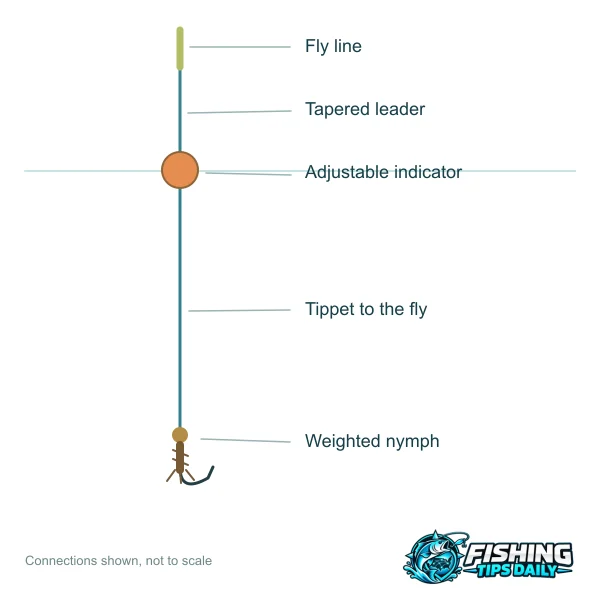
Match the rod, fly line, leader, tippet, and fly size so they cast and turn over together. Very fine tippet may struggle with a bulky streamer; a stiff heavy leader may spoil a tiny dry-fly presentation. A local fly shop can help match a starting outfit to the actual water.
Some flies can also be presented with spinning tackle and a suitable casting float where permitted. Rules for fly-only waters can define the required tackle and artificial flies specifically, so check before assuming any fly qualifies.