
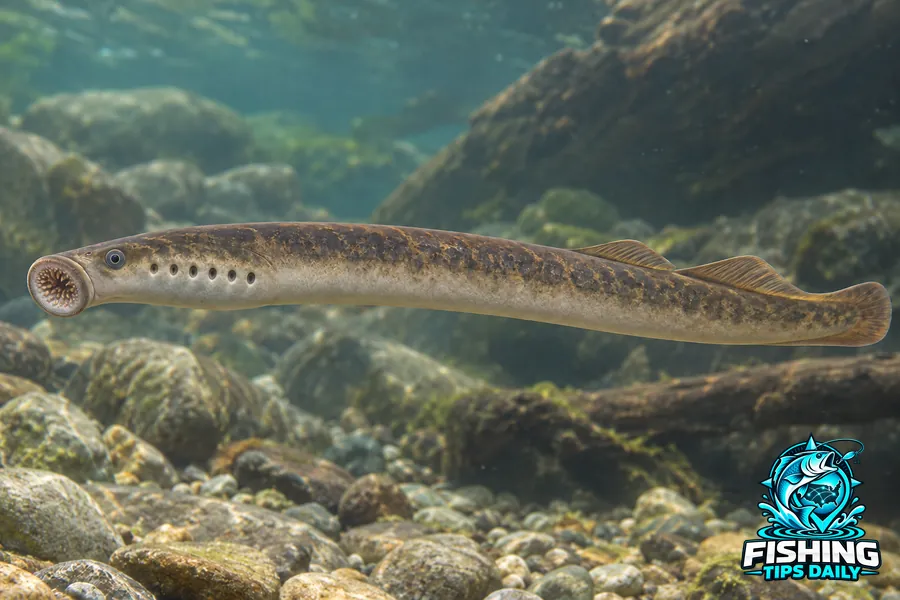
Range and Identity
Entosphenus tridentatus occurs around the North Pacific, with permanent freshwater populations also recorded. The ocean-going pattern should therefore be described as characteristic rather than universal. It is distinct from nonparasitic brook lampreys found in some of the same wider drainage systems.
Habitat and Behavior
Larvae occupy fine sediments in eddies, backwaters and stream margins. Feeding adults usually occur in marine water, while spawning adults return to gravel riffles and runs. These stage-specific habitats make life stage essential information in any lamprey observation.
Food and Life History
Parasitic adults obtain food from host animals, but feeding stops during the upstream reproductive migration. Adults die after spawning, and young develop in freshwater before transformation. The compiled upper references are seventy-six centimeters total length and five hundred grams, independent values rather than a paired specimen measurement.
Field Note
Preserve the connection between sediment habitat, migration routes and spawning gravel. Each supports a different part of the life cycle within the larger river-to-ocean system.
All Lakes With Pacific Lamprey
Browse lakes and reservoirs with documented Pacific Lamprey records, listed alphabetically. Records do not establish current abundance or public access. Check the evidence and managing authority for the water you choose.
Showing 1–2 of 2 lakes · Page 1 of 1
- Alexander Lake Matanuska-Susitna, AK
- Lake Four Matanuska-Susitna, AK