
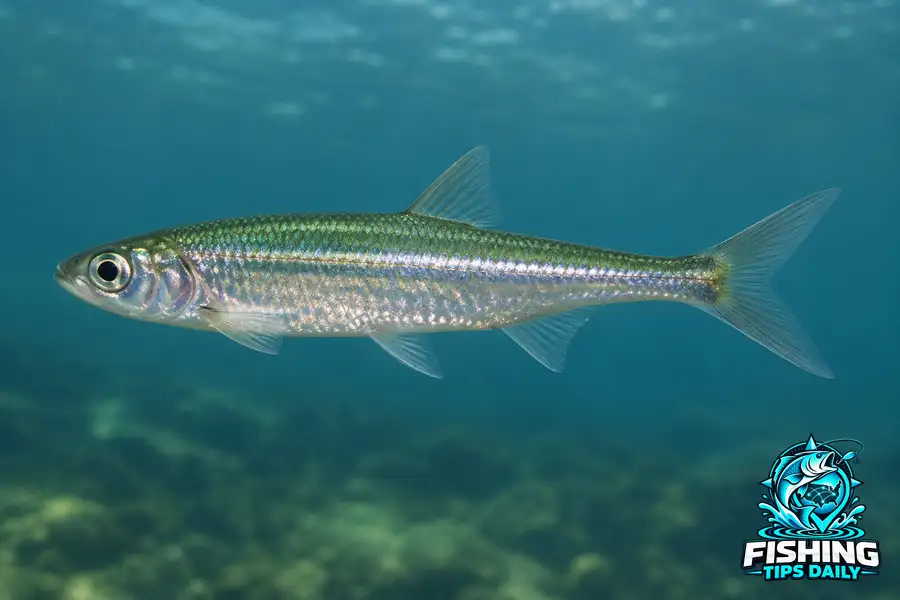
Distribution and Habitat
The species occurs broadly across Canada and the United States. Clear water over sand or gravel is commonly reported in lakes and rivers. Local abundance still depends on the particular waterbody rather than the breadth of the geographic range.
Schooling and Food
Schools feed on small crustaceans and other tiny foods, including midge larvae and algae. Surface-oriented feeding can be conspicuous near dusk, with fish returning toward deeper water around dawn. Observations made at different times can therefore look very different.
Size and Forage
The maximum total length is thirteen centimeters, while the common reference is 8.6 centimeters. Emerald Shiners are eaten by larger fishes and birds. When they are an important local forage, their narrow profile and actual school size can inform a baitfish imitation.
Observe at More Than One Time
A school absent from shallow water at midday may feed there near dusk. Timing is useful context for both fish surveys and angling observations.
All Lakes With Emerald Shiner
Browse lakes and reservoirs with documented Emerald Shiner records, listed alphabetically. Records do not establish current abundance or public access. Check the evidence and managing authority for the water you choose.
Showing 1–24 of 312 lakes · Page 1 of 13
- Aberdeen Lake Monroe, MS
- Albemarle Lake East Carroll, LA
- Aliceville Lake Pickens, AL
- Allatoona Lake Cherokee, GA
- Amber Lake Martin, MN
- Amory Pool Monroe, MS
- Anita Reservoir Yellowstone, MT
- Arapooish Pond Big Horn, MT
- Atoka Reservoir Atoka, OK
- Bankhead Lake Tuscaloosa, AL
- Barren River Lake Allen, KY
- Bass Lake Livingston, MI
- Bassett Lake St. Louis, MN
- Bear Lake Manistee, MI
- Beaver Lake Washington, AR
- Big Birch Lake Todd, MN
- Big Birch Lake Todd, MN
- Big Stone Lake Big Stone, MN
- Big Trout Lake Crow Wing, MN
- Big Twin Lake Martin, MN
- Bighorn Lake Big Horn, MT
- Birch Lake St. Louis, MN
- Birch Lake Osage, OK
- Black Duck Lake St. Louis, MN