
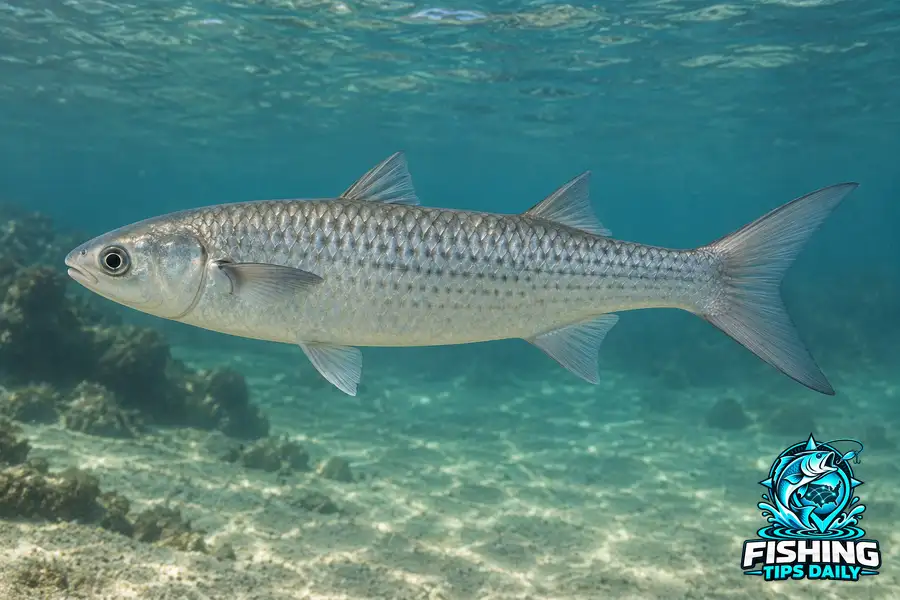
Identity
Older accounts use Chelon macrolepis or Liza macrolepis; many newer references use Planiliza macrolepis. Genetic research also indicates that some geographically separated populations assigned this name may represent distinct species. Broad range summaries therefore require care.
Size and Weight
The reported maximum is 60 cm standard length, roughly 23.6 inches measured without the tail fin. Common standard length is about 26 cm. A reliable maximum weight was not established from the material checked.
Habitat and Natural Food
Schools occupy shallow coastal waters and can extend from brackish reaches into freshwater. Recorded foods include diatoms, other small algae, organic debris and bottom-dwelling invertebrates. Young fish also consume copepods and floating algae.
Fishing Context
This mullet is harvested commercially, especially during spawning aggregations, and its roe is valued in some fisheries. These uses do not establish a species-specific best hook bait; methods and access depend on the local fishery.
A Life Across the Salinity Boundary
Freshwater occurrence does not make this an exclusively inland fish. Spawning takes place in marine water, where its eggs float rather than attach to the bottom. Connected estuarine habitat supports that transition between feeding and reproduction.
All Lakes With Bigscale Mullet
Browse all lakes and reservoirs with confirmed Bigscale Mullet records in our database, listed alphabetically.
No published lakes are currently linked to this species in our confirmed records.