
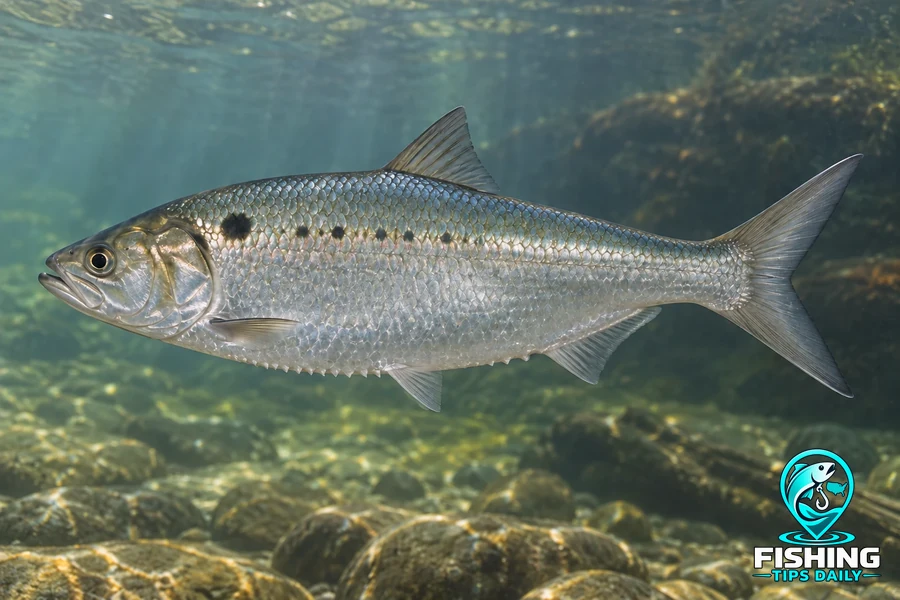
Identification and Life Cycle
This page covers Alosa sapidissima. It should not be confused with similarly named shad and herring species. Adults enter freshwater to reproduce, linking river habitat with the coastal ocean.
Bait and Fishing Methods
Documented Oregon methods include shad darts, tiny spoons and small grubs on jig heads. Anglers present these in moving water used by the run, often close to the bottom. Timing and presentation vary with river conditions; an Oregon method is not a universal seasonal rule.
Size and Weight
The maximum total length in a published summary is 76 cm, about 29.9 inches, and maximum weight is 5.5 kg, about 12.1 pounds. These are separate maxima. Oregon guidance describes fish around 3–5 pounds, showing how ordinary fishing size differs from the largest reports.
Habitat and Food
Young fish in freshwater and estuaries consume zooplankton and insect larvae. At sea, adults take crustaceans and other prey. Access to river spawning habitat is a key part of the life cycle.
An Ocean Fish Returns to the River
Spawning migrations concentrate American Shad into a seasonal river event. Native Atlantic populations and introduced Columbia River fish have different histories and conservation contexts. An abundant run in one river should not be used to describe the status of every population.
All Lakes With American Shad
Browse lakes and reservoirs with documented American Shad records, listed alphabetically. Records do not establish current abundance or public access. Check the evidence and managing authority for the water you choose.
Showing 1–6 of 6 lakes · Page 1 of 1
- Chapmans Pond Lower Connecticut River Valley, CT
- Connecticut River Reservoir Capitol, CT
- Pecausett Pond Lower Connecticut River Valley, CT
- Rainbow Pond Capitol, CT
- San Luis Reservoir Merced, CA
- Upper Priest Lake Bonner, ID