
Your Guide to Rod Power and Action
Walking into a tackle shop and seeing a wall of fishing rods can be overwhelming. All those different lengths, labels, and numbers can make your head spin. But here’s the good news: understanding rod power and action is much simpler than it looks, and it’s the key to picking the right tool for the job. Getting this right means more accurate casts, better fights, and more fish in the boat.
First, let’s talk about rod power. Think of power as the rod’s lifting strength. It’s how much force it takes to make the rod bend. An ultra-light power rod has the backbone to lift a small bag of sugar, while a heavy power rod is built to winch up something more like a bowling ball. Power ratings typically range from Ultra-Light and Light on the low end to Medium, Medium-Heavy, and Heavy on the high end. This rating tells you how much muscle the rod has for fighting fish and pulling them out of heavy cover like weeds or submerged trees.
Next up is rod action. While power is about strength, action describes where along the rod’s length it bends when you put pressure on the tip. A fast action rod bends mostly in the top third, near the tip. A moderate action rod bends closer to the middle, and a slow action rod bends all the way down into the handle. Action determines how a rod casts and how it behaves during a hookset. As fisheries experts at the Kentucky Department of Fish & Wildlife highlight, power is about strength while action is about flexibility.
These two ratings, power and action, are printed on the rod blank, usually right above the handle. They are separate measurements but work together to define a rod’s performance. Understanding them is the first step to building a more effective setup, and our complete fishing rod guide can walk you through every other detail you need to know.
Decoding the Ratings on Your Rod
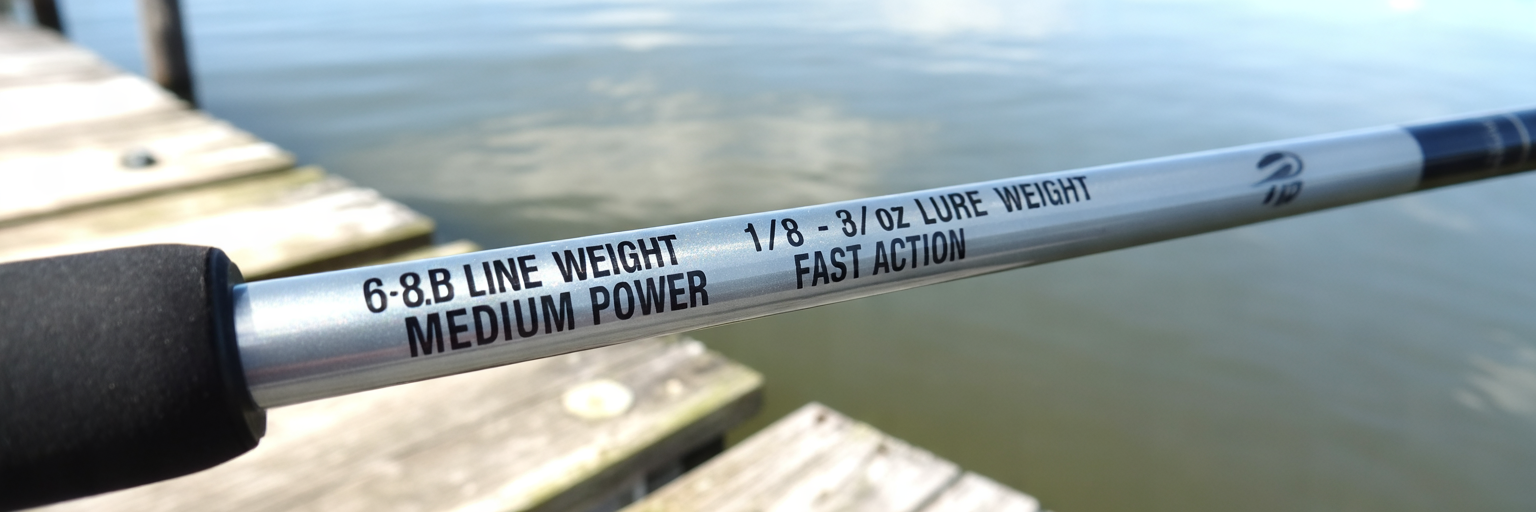
Now that you know what power and action mean, let’s look at how to use the other numbers printed on your rod. These ratings are not just suggestions. They are the manufacturer’s instructions for getting the best performance and safety out of your gear. Getting a handle on what these fishing rod ratings explained on the blank mean will make you a much more effective angler.
Lure Weight and Line Strength Ratings
You will almost always see a lure weight range, like “1/4 – 3/4 oz.” This tells you the ideal weight needed to properly “load” the rod during a cast. When you bring the rod back to cast, the lure’s weight bends it, storing energy that is then released to propel the lure forward. If your lure is too light for the rod, it won’t bend enough, and your cast will be short and awkward. If it’s too heavy, it will overload the rod, making it feel sluggish and inaccurate. It also increases the risk of breaking your rod tip.
Next to the lure weight, you’ll find a line strength rating, such as “8-17 lb test.” This range is critical for one big reason: safety. Your rod is designed to handle a certain amount of strain. If you use a line that is much heavier than recommended, like 30-pound braid on a rod rated for 10-pound line, the line might not break when you get snagged on the bottom. Instead, all that pressure goes straight to the rod, which could snap under the load. Sticking to the recommended line strength ensures the line will be the weak point, saving your rod and reel from damage.
How Action Affects Your Hookset
Rod action has a direct impact on how you set the hook. A fast action rod has a stiff backbone with a flexible tip. When a fish bites, a quick snap of your wrist transfers energy directly to the hook point, driving it home with serious power. This is perfect for single-hook lures like jigs, Texas rigs, and worms, where you need to penetrate a fish’s tough mouth instantly.
A moderate action rod, on the other hand, bends more through its midsection. This slower, more forgiving bend acts like a shock absorber. When a fish strikes a lure with small treble hooks, like a crankbait, this give prevents you from ripping the hooks out of its mouth. It gives the fish an extra split second to fully eat the bait and keeps steady pressure on it during the fight, which is crucial for keeping those tiny hooks pinned.
Matching Power and Action to Your Lures
With the ratings decoded, the next step is matching your rod’s action to the lure you’re throwing. Different lures perform best with different rod actions, and getting this pairing right will make your presentations more effective and help you land more fish. Here’s a simple breakdown.
- Fast Action Rods: For Feeling the Bite
These rods are the champions of sensitivity. Because only the tip flexes, vibrations from the lure travel down the stiff blank directly to your hand. This makes them ideal for any bottom-contact technique where feeling a subtle bite is everything. Think jigs, soft plastic worms, and Texas rigs. The instant you feel that “tick” of a bite, the rod’s powerful backbone is ready to drive the hook home with authority. - Moderate Action Rods: For Moving Baits
These are your go-to rods for what anglers call “reaction baits.” Lures like crankbaits, spinnerbaits, and bladed jigs are meant to be retrieved steadily, and a moderate action rod excels here. The deeper bend allows a fish to fully engulf a moving lure before it feels resistance. It also helps keep treble hooks from tearing free during aggressive head shakes. This forgiving action is a huge advantage when throwing some of the best lures for muddy water, where fish often strike with less precision. - Slow Action Rods: For Finesse and Big Fights
Slow action rods are more of a specialty tool. Their deep, parabolic bend is excellent for casting very lightweight baits for panfish or trout, as the entire rod loads up to fling the lure. This deep bend also serves as an excellent shock absorber, protecting light lines from breaking when fighting surprisingly large fish.
As a simple rule, if you need to feel the bite, choose fast action. If the fish needs to eat a moving bait, choose moderate action.
Choosing the Right Rod for Your Target Fish

We’ve covered power, action, and lures. Now let’s connect it all to the fish you’re actually trying to catch. While there are endless combinations, a few proven setups will cover most freshwater situations and help you feel confident on the water.
For many anglers, the target is largemouth bass. If you’re looking for the single best rod for bass fishing, a Medium-Heavy power, Fast action casting or spinning rod is the undisputed workhorse. It has enough backbone to pull fish from cover and the sensitivity needed for jigs and plastics. It can also handle spinnerbaits and other moving baits in a pinch, especially when paired with some of the best lures for bass. For anglers who love throwing crankbaits, adding a Medium power, Moderate action rod is a smart move to keep those treble hooks pinned.
If you’re chasing crappie or trout, finesse is the name of the game. A Light or Medium-Light power rod with a Fast action is perfect. The light power helps cast tiny jigs and spinners, while the fast action provides the sensitivity to detect the subtle “thump” of a crappie bite. For trout in streams, a moderate action can also work well to protect light leaders.
For catfish anglers, strength and durability are key. A Medium-Heavy or Heavy power rod with a Moderate action is the ideal choice. The power helps manage heavy sinkers and control powerful fish in current, while the moderate action allows a catfish to swim off with the bait before feeling too much resistance, leading to better hookups with circle hooks.
| Target Fish | Recommended Power | Recommended Action | Common Techniques & Lures |
|---|---|---|---|
| Largemouth Bass (All-Around) | Medium-Heavy | Fast | Jigs, Texas Rigs, Spinnerbaits |
| Largemouth Bass (Crankbaits) | Medium | Moderate | Shallow and Medium-Diving Crankbaits |
| Crappie & Panfish | Light / Ultra-Light | Fast | Small Jigs, Spinners, Live Bait Rigs |
| Trout (Streams & Ponds) | Light | Moderate or Fast | Spinners, Spoons, Finesse Baits |
| Catfish (Channel & Blue) | Medium-Heavy / Heavy | Moderate | Circle Hooks, Slip Sinker Rigs, Cut Bait |
Note: These are proven starting points. Your choice may vary based on lure weight, cover density, and personal preference.
Your First Step to a Better Setup
Feeling more confident? You should be. You now understand the two most important factors in a fishing rod’s performance. Just remember the basics: power is for fighting strength, and action is for casting and hook-setting. The next time you pick up a rod, look at the blank just above the handle and you’ll know exactly what it’s designed to do.
For fishing rods for beginners who feel overwhelmed by the options, here is a simple, practical starting point: a 6’6″ to 7′ rod with Medium power and Fast action is an incredibly versatile first purchase. It can handle a wide variety of lures and species, from bass and walleye to larger trout. Ultimately, knowing how to choose a fishing rod comes down to matching these ratings to your goals on the water.
These are guidelines, not unbreakable rules. The best way to learn is to get out there and experiment. Pay attention to how your rod feels with different lures and see what works for you. Understanding these fundamentals is the first step to making smarter gear choices and having more fun fishing. To find great places to test your new knowledge, check out the resources here at Fishing Tips Daily.