
Jerkbait Fishing
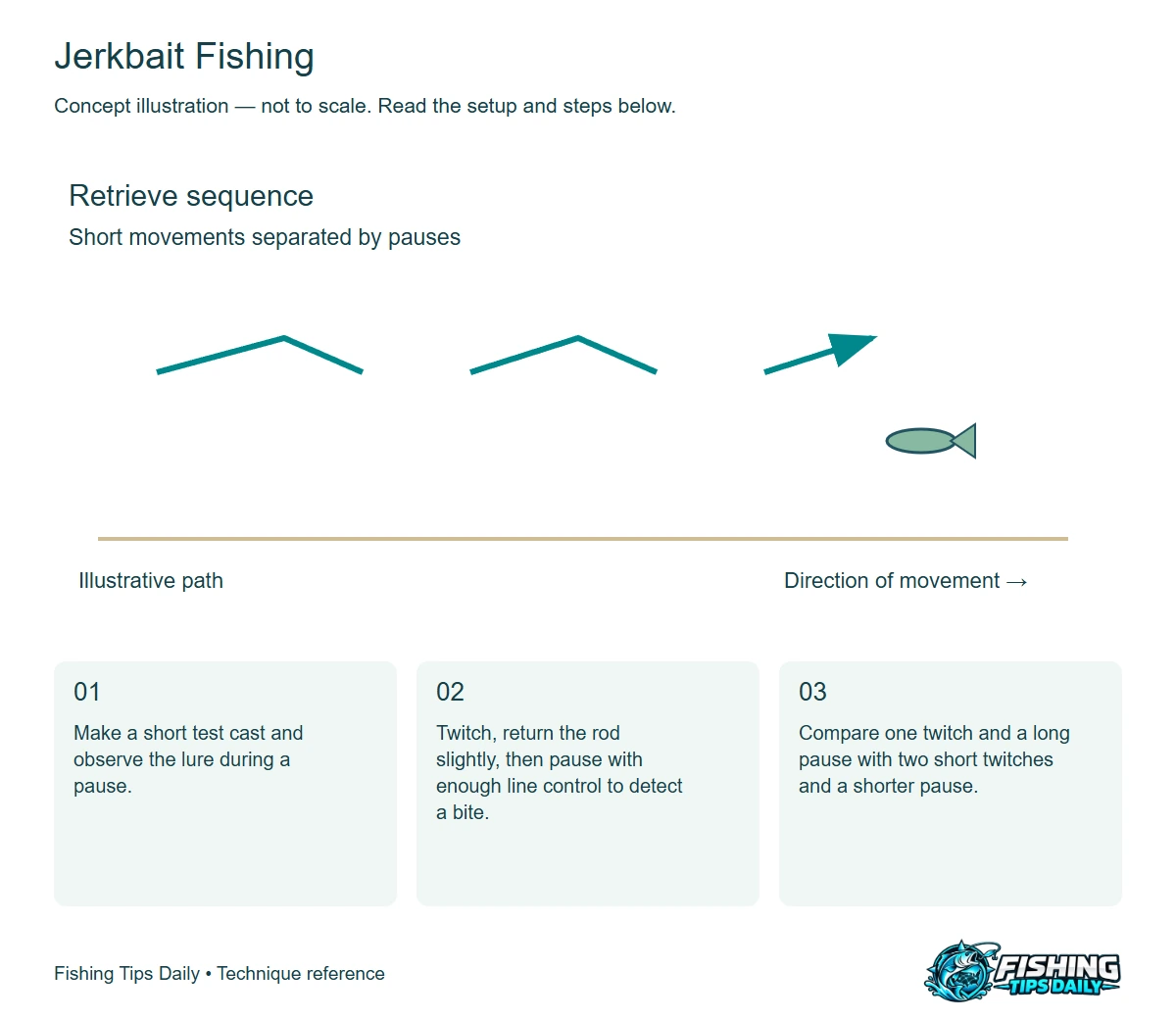
Jerkbait fishing combines short directional movements with pauses. The pause is part of the presentation: a floating, sinking, or suspending lure behaves differently when the rod stops moving.
Build a setup that does the job.
Choose a jerkbait rated for the working depth and an outfit that comfortably casts its weight. Check buoyancy in the actual water; leader, hooks, and temperature can affect a supposedly suspending model.
Make the first test close enough to observe. Check the connection, the hook opening, and whether the offering follows the intended path. Correct a fouled or poorly balanced setup before adding distance.
How to fish it, step by step.
- Make a short test cast and observe the lure during a pause.
- Retrieve it to its working depth before starting the twitching cadence.
- Twitch, return the rod slightly, then pause with enough line control to detect a bite.
- Compare one twitch and a long pause with two short twitches and a shorter pause.
- When the line jumps or loads, reel into contact and set with controlled pressure appropriate to treble hooks.
A useful first test.
Beside a rocky point, hold the same casting angle for several casts while extending the pause. If a fish takes after a long stop, record the pause as well as the lure choice.
Keep the productive detail repeatable: position, depth, speed, or pause. Change one of those at a time so you can tell what improved the presentation.
Variations—and what changes.
Hard jerkbaits, soft jerkbaits, and floating minnow plugs share a profile but need different rigs and depths. This guide focuses on hard minnow baits; soft versions are covered with plastics.
Read the symptom before changing everything.
Lure only pulls forward
The rod is dragging against tight line; shorten the motion and allow recovery slack.
Bites go unnoticed
Do not dump uncontrolled slack. Watch where the line enters the water during the pause.
Know when to change methods.
If the offering cannot reach the target, repeatedly snags, or demands equipment you cannot control comfortably, choose another presentation from this family. Keep the location clue you learned; changing a rig does not require starting the whole search over.
Use tackle and bait permitted on the water, and plan safe access and fish handling. The illustrations explain concepts; they do not replace equipment instructions or current local rules.