
Crankbait Fishing
A crankbait uses its body and bill, or a lipless vibrating design, to create action as you retrieve. Productive casts keep that action at a useful depth for as much of the retrieve as possible.
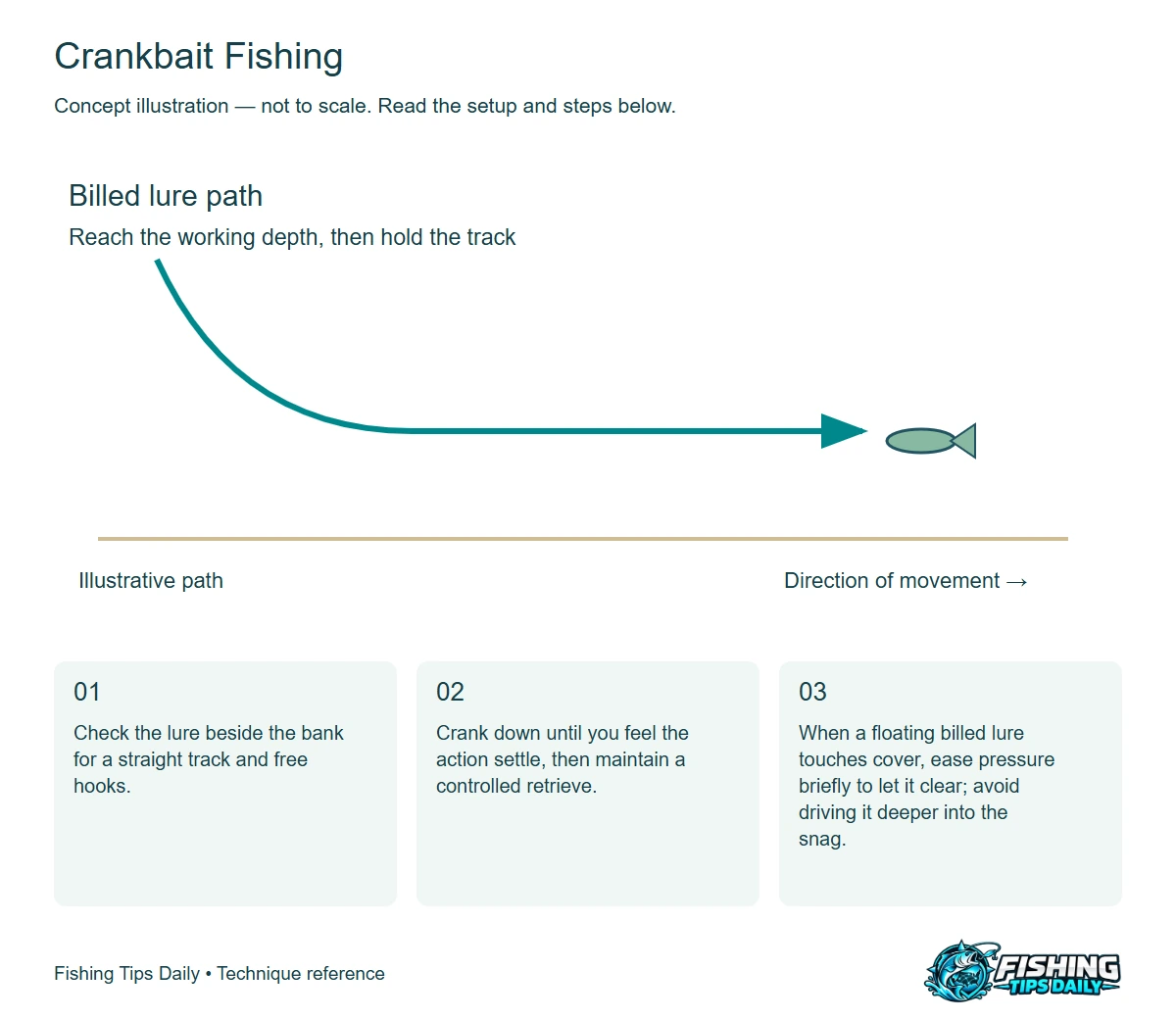
Build a setup that does the job.
Use a rod rated for the lure and capable of cushioning treble hooks, a balanced reel, and suitable line. A billed lure has an intended running range, but line diameter, cast length, rod angle, and speed change its actual depth.
Make the first test close enough to observe. Check the connection, the hook opening, and whether the offering follows the intended path. Correct a fouled or poorly balanced setup before adding distance.
How to fish it, step by step.
- Check the lure beside the bank for a straight track and free hooks.
- Cast along or diagonally across the depth contour rather than always straight offshore.
- Crank down until you feel the action settle, then maintain a controlled retrieve.
- When a floating billed lure touches cover, ease pressure briefly to let it clear; avoid driving it deeper into the snag.
- After a bite, repeat the running depth and angle. Land the fish without grabbing exposed trebles.
A useful first test.
On a gravel point, compare a diagonal cast that touches bottom midway with a parallel cast that stays in contact longer. Keep the useful angle and only then compare colors or retrieve pauses.
Keep the productive detail repeatable: position, depth, speed, or pause. Change one of those at a time so you can tell what improved the presentation.
Variations—and what changes.
Squarebill, round-bill, deep-diving, and lipless crankbaits do different jobs. Lipless lures sink and can be lifted or counted down; a floating billed crankbait normally rises when stopped.
Read the symptom before changing everything.
Lure pulls sideways
Check a fouled hook, debris, or damage before trying more speed.
Constant wedging
Choose a shallower runner or change casting angle rather than repeatedly forcing the bill into the same gap.
Know when to change methods.
If the offering cannot reach the target, repeatedly snags, or demands equipment you cannot control comfortably, choose another presentation from this family. Keep the location clue you learned; changing a rig does not require starting the whole search over.
Use tackle and bait permitted on the water, and plan safe access and fish handling. The illustrations explain concepts; they do not replace equipment instructions or current local rules.