
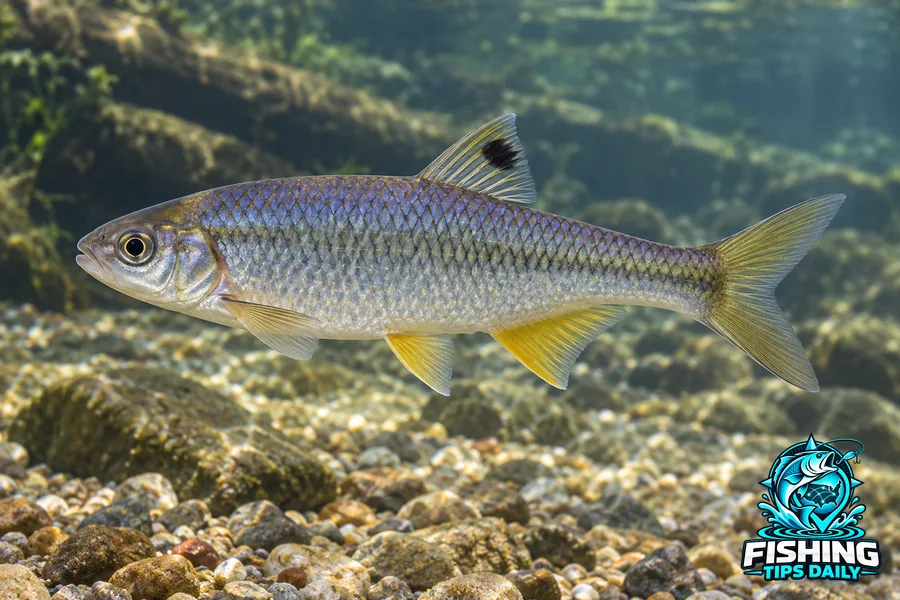
Range and Identity
Cyprinella spiloptera occurs across several eastern and central North American drainage regions. The broad range includes Atlantic and interior systems, but not every Great Lakes waterbody. Precise drainage information is useful when comparing it with similar shiners.
Habitat and Behavior
Adults use sandy and gravelly runs and pools in creeks and rivers. They feed on surface insects and aquatic immatures, linking food from above the stream with prey developing within it. Local current and cover help describe the actual feeding position.
Food and Life History
The upper reference is twelve centimeters total length, with 7.7 centimeters as a common size. Eggs are deposited in crevices of rocks or logs and defended by males. Regional summer spawning dates should not be treated as a fixed calendar for every population.
Field Note
Leave occupied crevices undisturbed when observing breeding fish. The narrow gap beneath a log or between rocks can be an active egg site rather than simply empty shelter.
All Lakes With Spotfin Shiner
Browse lakes and reservoirs with documented Spotfin Shiner records, listed alphabetically. Records do not establish current abundance or public access. Check the evidence and managing authority for the water you choose.
Showing 1–24 of 165 lakes · Page 1 of 7
- Amber Lake Martin, MN
- Ballantyne Lake Blue Earth, MN
- Barrett Lake Grant, MN
- Baw Beese Lake Hillsdale, MI
- Beason Lake Scott, MN
- Beebe Lake Wright, MN
- Big Carnelian Lake Washington, MN
- Big Fish Lake Stearns, MN
- Big Lake Sherburne, MN
- Big Marine Lake Washington, MN
- Big Pine Lake Otter Tail, MN
- Big Stone Lake Big Stone, MN
- Bishop Lake Livingston, MI
- Bowen Lake Cass, MN
- Bright Lake Martin, MN
- Browns Lake Stearns, MN
- Bryant Lake Hennepin, MN
- Budd Lake Martin, MN
- Buffalo Lake Wright, MN
- Cedar Island Lake Stearns, MN
- Cedar Lake Martin, MN
- Chisago Lake Chisago, MN
- Christmas Lake Hennepin, MN
- Clark Lake Jackson, MI