
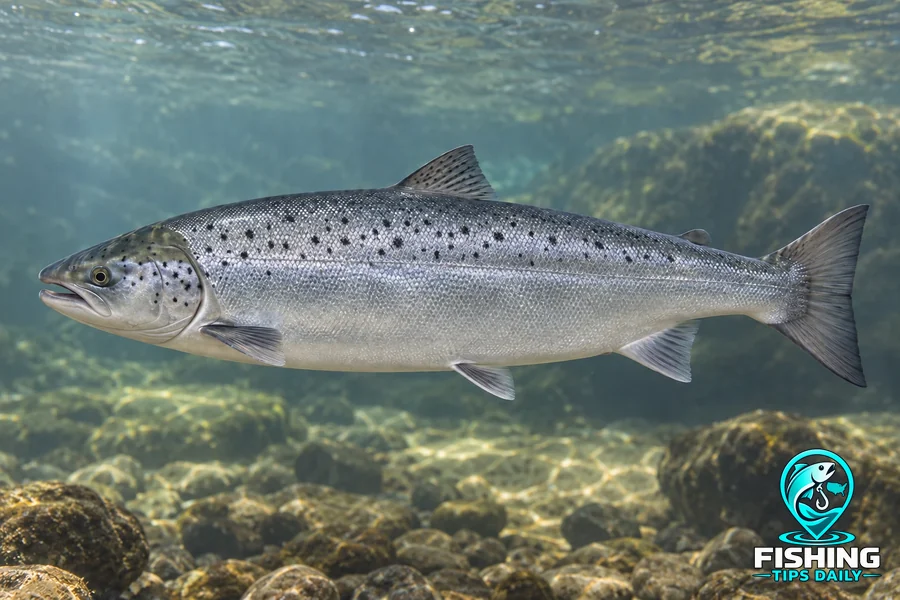
Bait and Fishing Methods
For landlocked salmon, streamer flies and lures resembling smelt are established choices. Spring and fall fish can feed near shore and the surface; summer fish often move deeper, where controlled-depth trolling can be productive. River anglers also use dry flies and nymphs. These methods concern legal landlocked fisheries. Wild sea-run Atlantic Salmon in Maine are protected and must not be targeted.
Size and Weight
A NOAA account describes a largest Atlantic Salmon of 60 inches and 105 pounds, approximately 152.4 cm and 47.6 kg. Those exceptional species figures are not normal lake-fish sizes. Gulf of Maine adults returning after two sea winters commonly weigh about 7–12 pounds. Landlocked populations have their own growth conditions and should not be judged against giant sea-run fish.
Habitat and Natural Food
Young salmon use freshwater streams. Sea-run fish later grow in the ocean, whereas landlocked fish use lakes. Rainbow Smelt is especially important forage in Maine’s landlocked fisheries. Food supply, suitable temperatures and spawning habitat all influence a lake population.
Reproduction
Adults return to freshwater spawning areas and bury eggs in gravel. Atlantic Salmon can survive spawning and reproduce again. This differs from the once-only spawning pattern familiar from many Pacific salmon species.
A Return Journey That Can Repeat
Spawning need not end an Atlantic Salmon’s life. Survivors can recover and make another spawning run. The number of repeat spawners varies, so this ability does not mean every adult survives or returns the following year.
All Lakes With Atlantic Salmon
Browse lakes and reservoirs with documented Atlantic Salmon records, listed alphabetically. Records do not establish current abundance or public access. Check the evidence and managing authority for the water you choose.
Showing 1–24 of 396 lakes · Page 1 of 17
- Alamoosook Lake Hancock, ME
- Alford Lake Knox, ME
- Alligator Lake Hancock, ME
- Arnold Pond Franklin, ME
- Attean Pond Somerset, ME
- Austin Pond Somerset, ME
- Aziscohos Lake Oxford, ME
- B Pond Oxford, ME
- B Pond Piscataquis, ME
- Baker Lake Somerset, ME
- Baker Pond Somerset, ME
- Baker Pond Somerset, ME
- Barrows Lake Washington, ME
- Bay of Naples Cumberland, ME
- Bear Pond Oxford, ME
- Beatons Lake Gogebic, MI
- Beau Lake Aroostook, ME
- Beaver Pond Franklin, ME
- Beech Hill Pond Hancock, ME
- Berry Bay Carroll, NH
- Big Benson Pond Piscataquis, ME
- Big Houston Pond Piscataquis, ME
- Big Lake Washington, ME
- Big Machias Lake Aroostook, ME