
Topwater Fishing
Topwater fishing keeps a lure on or at the surface so fish can see, hear, or feel it overhead. The useful skill is controlling distance and pauses near cover, rather than making the maximum amount of noise.
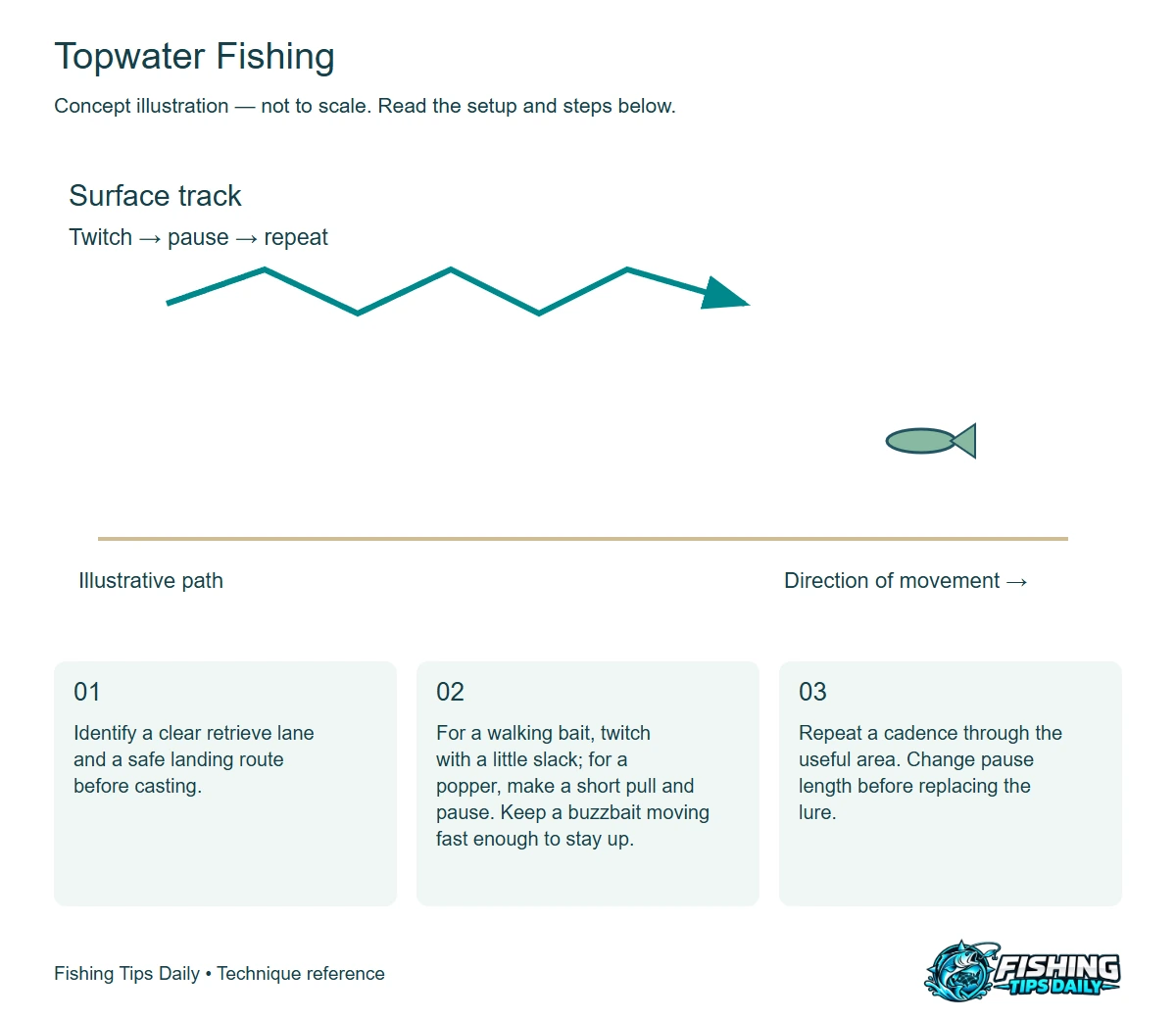
Build a setup that does the job.
Choose a floating walking bait, popper, buzzbait, or hollow-body frog for the cover. Open treble hooks suit open lanes; a protected frog hook suits vegetation. Match rod power and line to the hook and cover, not just lure length.
Make the first test close enough to observe. Check the connection, the hook opening, and whether the offering follows the intended path. Correct a fouled or poorly balanced setup before adding distance.
How to fish it, step by step.
- Identify a clear retrieve lane and a safe landing route before casting.
- Cast past the feature, then take up loose line without pulling the lure away from it.
- For a walking bait, twitch with a little slack; for a popper, make a short pull and pause. Keep a buzzbait moving fast enough to stay up.
- Repeat a cadence through the useful area. Change pause length before replacing the lure.
- When a fish strikes, wait until you feel the fish load the line before responding with a hookset suited to the lure.
A useful first test.
Along a weed opening, walk a bait through the open lane, then pause at the edge. If a bass boils behind it, follow with a slower presentation to the same spot instead of repeatedly ripping the topwater away.
Keep the productive detail repeatable: position, depth, speed, or pause. Change one of those at a time so you can tell what improved the presentation.
Variations—and what changes.
Walking, popping, prop-bait retrieves, buzzbaits, and frogs belong here. A walking lure needs lateral cadence; a buzzbait needs continuous forward movement. They are not interchangeable instructions.
Read the symptom before changing everything.
Lure will not walk
Too much tight-line pulling makes it track straight; shorten the twitch and return a little slack.
Splash but no hookup
Avoid striking at the sight of the splash alone. Check hook sharpness and wait for weight.
Know when to change methods.
If the offering cannot reach the target, repeatedly snags, or demands equipment you cannot control comfortably, choose another presentation from this family. Keep the location clue you learned; changing a rig does not require starting the whole search over.
Use tackle and bait permitted on the water, and plan safe access and fish handling. The illustrations explain concepts; they do not replace equipment instructions or current local rules.