
Fly Casting Basics
Fly casting uses the mass of the fly line to carry the leader and fly. A controlled loop and accurate delivery matter more than the longest possible cast.
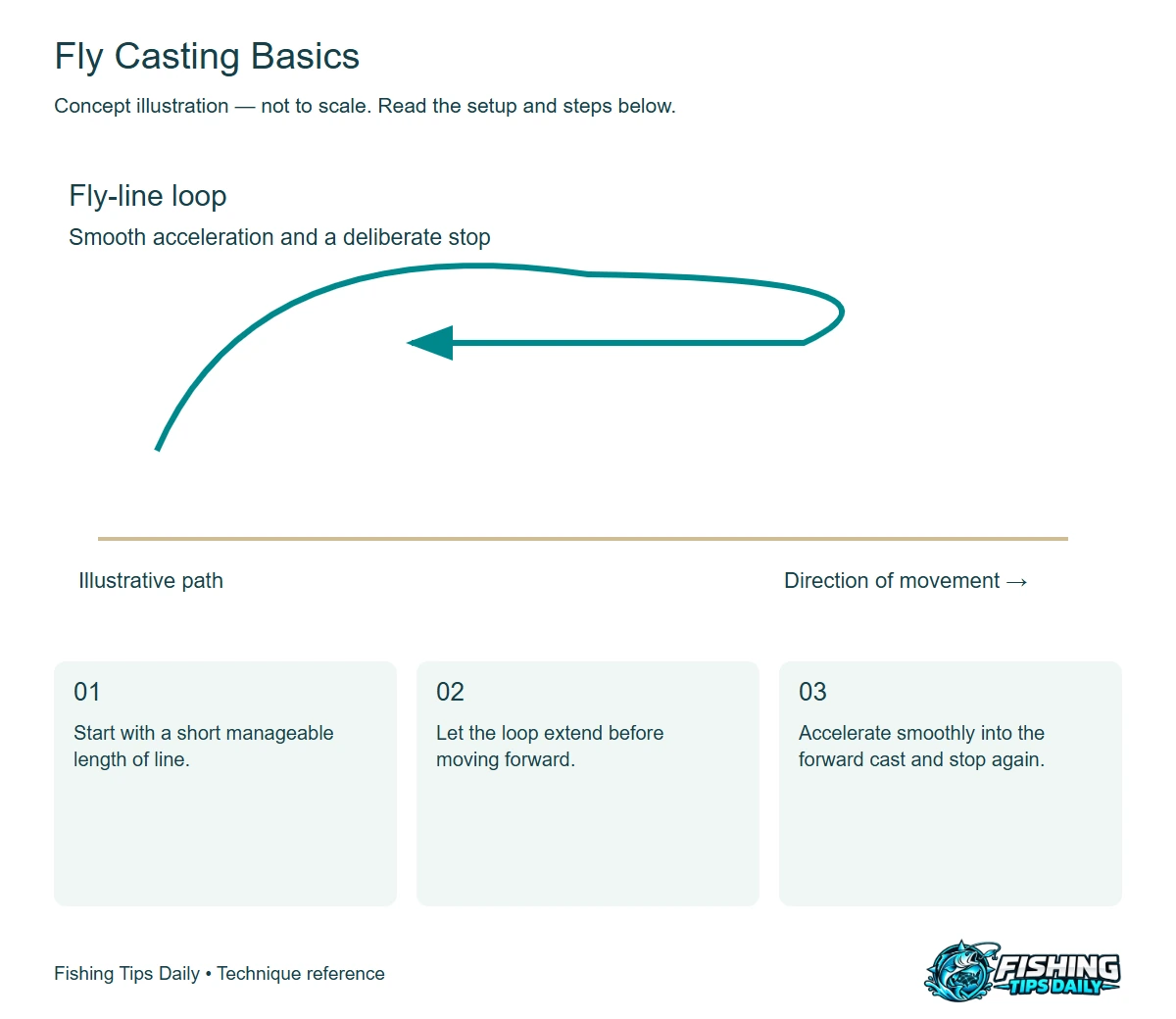
Build a setup that does the job.
Match fly line to the rod’s rating and use a suitable leader. Wear eye protection and avoid trying to cast a heavy or wind-resistant fly with an outfit that cannot control it.
Make the first test close enough to observe. Check the connection, the hook opening, and whether the offering follows the intended path. Correct a fouled or poorly balanced setup before adding distance.
How to fish it, step by step.
- Start with a short manageable length of line.
- Lift smoothly into the backcast and stop the rod deliberately.
- Let the loop extend before moving forward.
- Accelerate smoothly into the forward cast and stop again.
- Lower the tip as the line lands; shorten the cast when accuracy suffers.
A useful first test.
On a small stream, a short accurate cast to a seam is often more useful than a long cast across several conflicting currents. Practice landing the leader without slapping the fly onto the target.
Keep the productive detail repeatable: position, depth, speed, or pause. Change one of those at a time so you can tell what improved the presentation.
Variations—and what changes.
Roll casts help when backcast room is limited. False casting repositions or dries line but adds opportunities for tangles; use only what the presentation needs.
Read the symptom before changing everything.
Line collapses behind you
Check that the backcast has time and clearance to extend.
Knots appear in the leader
Reduce force and inspect a tailing loop; do not simply cast harder.
Know when to change methods.
If the offering cannot reach the target, repeatedly snags, or demands equipment you cannot control comfortably, choose another presentation from this family. Keep the location clue you learned; changing a rig does not require starting the whole search over.
Use tackle and bait permitted on the water, and plan safe access and fish handling. The illustrations explain concepts; they do not replace equipment instructions or current local rules.