
Fishing skills
Three Fishing Knots to Learn—and How to Check Them
Learn a small number of knots well enough to tie and inspect them consistently. These three cover common terminal connections and a simple similar-diameter leader connection. Match the knot to the actual line; the line maker's instructions take priority over a universal knot claim.
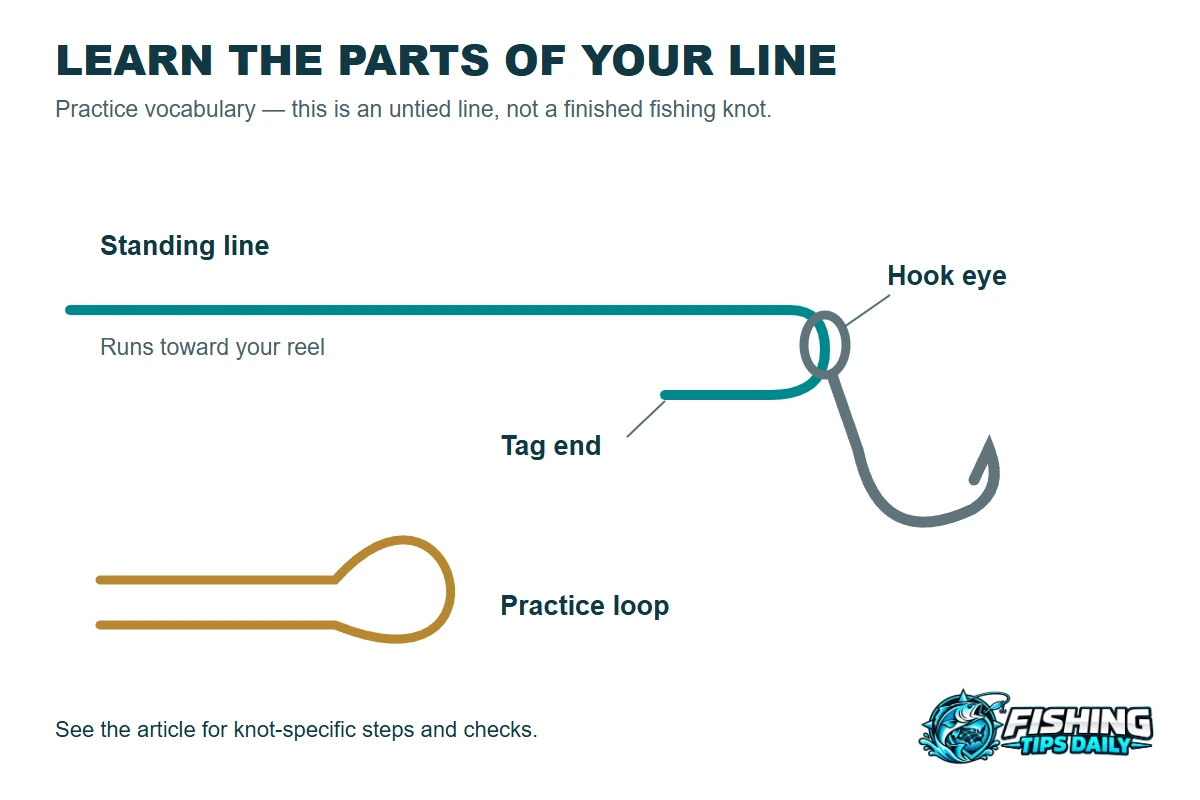
Know which end you are moving
The standing line runs back toward the reel. The tag end is the short free end you manipulate. A loop is a doubled opening in the line. Learn those terms with a large practice cord and a smooth ring before trying to tie fine line beside the water.
Inspect the hook eye or swivel for roughness. A correct knot against a damaged edge can still fail. Leave enough working line to tie neatly and keep hook points controlled while practicing. Never hold a bare hook in your mouth or wrap fine line around your fingers to test strength.
Improved clinch: a common nylon terminal connection
Pass the tag through the hook eye and wrap it around the standing line about five to seven times for a typical manageable nylon line. Bring the tag back through the small opening immediately beside the eye, then through the larger loop you just formed. Moisten and draw the coils down gradually without crossing them.
Seat the knot firmly, check that the wraps lie together, and trim only after testing. Wrap count and suitability vary with line diameter and material. Do not assume this version is suitable for slippery braid. If coils bunch, the tag slips, or the line looks damaged, cut it off and retie.
Palomar: a doubled-line terminal knot
Double a working length of line and pass the loop through the eye. Tie a loose overhand knot with the doubled line, leaving a loop large enough to pass over the entire hook or lure. Pass the tackle through that loop, then bring the loop clear of the hook bend and any hardware.
Moisten as appropriate for the line and tighten carefully so the strands seat without crossing or trapping the loop. A large treble-hook lure can make this awkward; protect the points and leave enough room. Check the line maker's recommendation, particularly for braid or stiff fluorocarbon, and test the finished knot.
Double surgeon's knot: joining compatible leaders
Overlap two suitable lines with their free ends pointing in opposite directions. Form a loop with the overlapped pair and pass the short end of the main line and the entire leader end through it twice. Moisten and draw all four ends so the knot seats evenly.
This is a simple option for compatible, reasonably similar-diameter nylon leader sections, not a universal braid-to-heavy-leader solution. A long leader must pass through the loop, which can be awkward after tackle is attached. Test for slippage and check whether the finished knot passes through your guides comfortably if it will be reeled through them.
Inspect before trimming and inspect again after damage
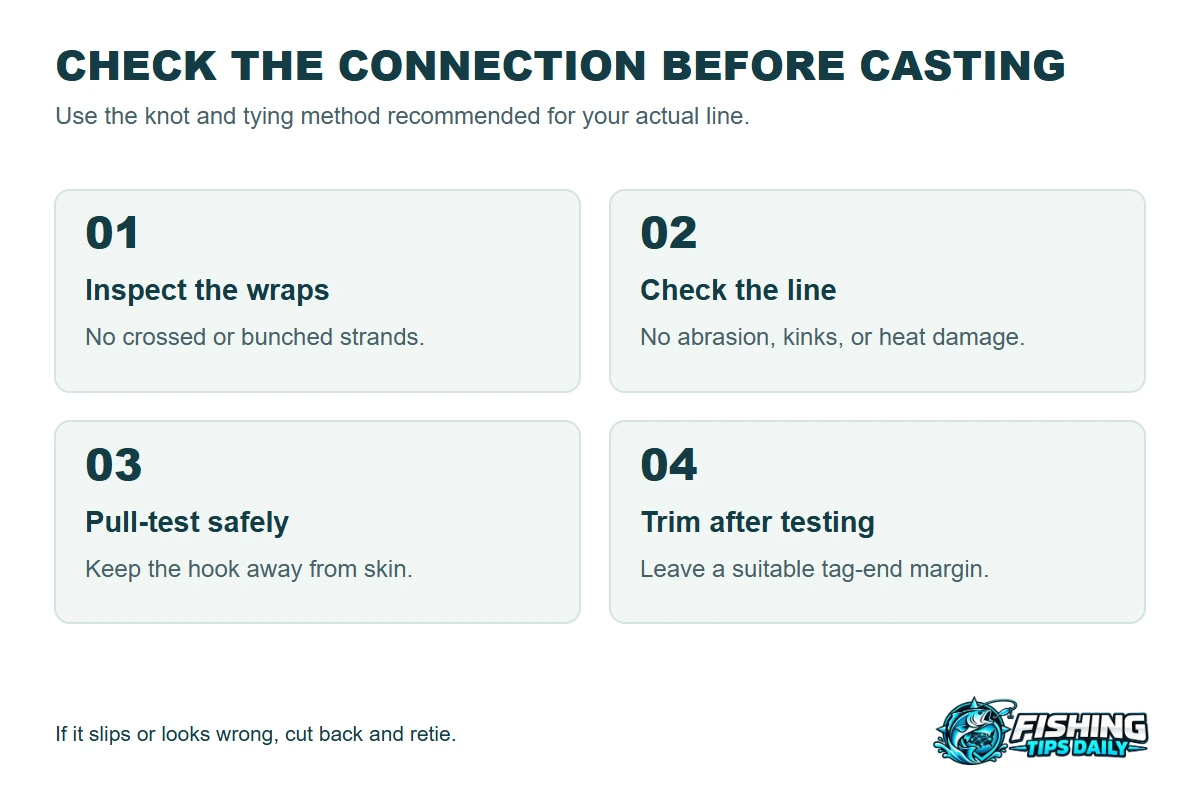
A dependable connection has orderly wraps, no burned or kinked section, and no moving tag under a firm controlled pull. Use a safe grip or suitable tool while keeping the hook away from skin. Do not assign a guaranteed strength percentage to a knot tied with unknown line and technique.
Retie after abrasion, a hard snag, visible damage, or a connection that no longer looks correct. Practice at home until you can tie each chosen knot without guessing which loop comes next. A simple knot you can verify is better than an elaborate one you cannot inspect.
Quick comparison
| Knot | Typical job | Important limit |
|---|---|---|
| Improved clinch | Nylon to hook or swivel | Not a default for slippery braid |
| Palomar | Terminal connection using doubled line | Loop must clear the entire tackle |
| Double surgeon's | Compatible similar-diameter leaders | Not a universal heavy braid-to-leader knot |
A five-minute practice drill
Use cord and a smooth ring to learn the sequence, then tie the same knot in the actual fishing line. Inspect, pull-test safely, and repeat several times. If one attempt looks different, identify the crossed wrap or wrong loop instead of keeping it. Practice joining leaders before a trip so you are not learning with cold hands beside the water.
When it is not working
- The tag slides during testing
- Retie with the correct knot and wraps for the material.
- The line looks curled or damaged near the knot
- Cut back to undamaged line and seat more carefully.
- The Palomar loop catches on a hook
- Use a larger working loop and control the points before tightening.
Common questions
Which knot is strongest?
There is no single answer across all materials, diameters, and tying quality. Use a suitable knot and test your own connection.
How short should I trim the tag?
Leave an appropriate margin for the line and knot rather than cutting flush; follow the line maker's guidance.