
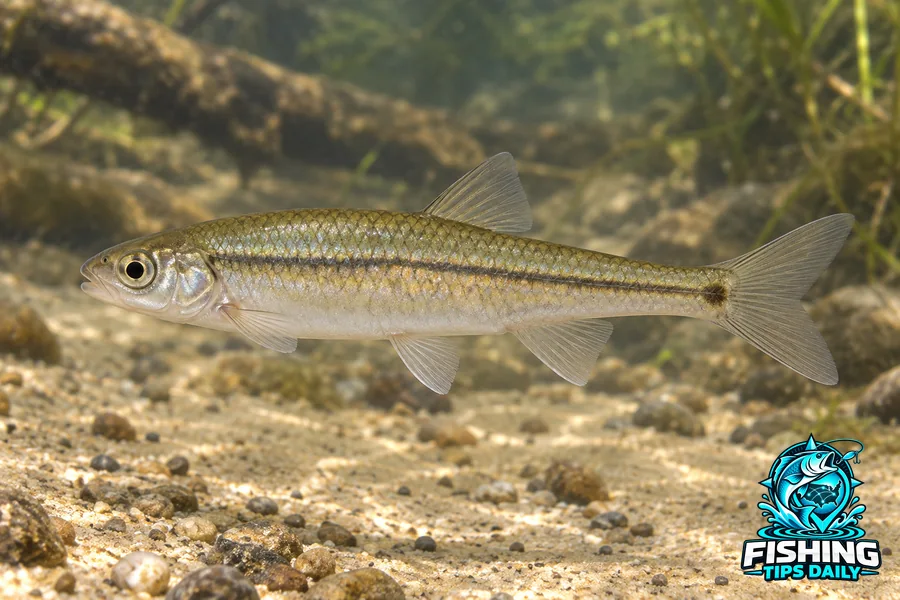
Range and Identity
Notropis stramineus has a broad distribution through northern and central North American drainage systems and south into parts of the Rio Grande region. That broad range describes many separate river populations rather than uniform occupancy of every intervening waterbody.
Habitat and Behavior
Adults inhabit sandy or gravelly runs and pools in creeks and rivers, and also sandy lake margins. Clear creeks and small rivers are frequent settings. Its food includes detritus and small invertebrates, especially midge larvae and small mayfly nymphs taken from the bottom or the drift.
Food and Life History
The reported maximum is 8.2 centimeters total length, with 4.4 centimeters as a common reference. Reproduction is described as broadcast spawning. This differs from assuming that every minnow constructs or guards a visible nest.
Field Note
Note whether feeding fish are holding over the bottom or taking drifting material. Both observations fit the documented feeding ecology and can occur within the same run.
All Lakes With Sand Shiner
Browse lakes and reservoirs with documented Sand Shiner records, listed alphabetically. Records do not establish current abundance or public access. Check the evidence and managing authority for the water you choose.
Showing 1–24 of 148 lakes · Page 1 of 7
- Ballantyne Lake Blue Earth, MN
- Baptist Lake Newaygo, MI
- Bass Lake Livingston, MI
- Bass Lake Mason, MI
- Bass Lake Crow Wing, MN
- Baw Beese Lake Hillsdale, MI
- Bear Lake Hillsdale, MI
- Bear Lake Manistee, MI
- Beaver Lake Alger, MI
- Big Star Lake Lake, MI
- Big Stone Lake Big Stone, MN
- Birch Lake Antrim, MI
- Bishop Lake Livingston, MI
- Black Lake Cheboygan, MI
- Brownlee Lake Alcona, MI
- Burt Lake Cheboygan, MI
- Cedar Lake Leelanau, MI
- Clam Lake Antrim, MI
- Cow Creek Reservoir Blaine, MT
- Crooked Lake Emmet, MI
- Crystal Lake Benzie, MI
- Current Reservoir Phillips, MT
- Deer Lake Charlevoix, MI
- Derby Lake Montcalm, MI