
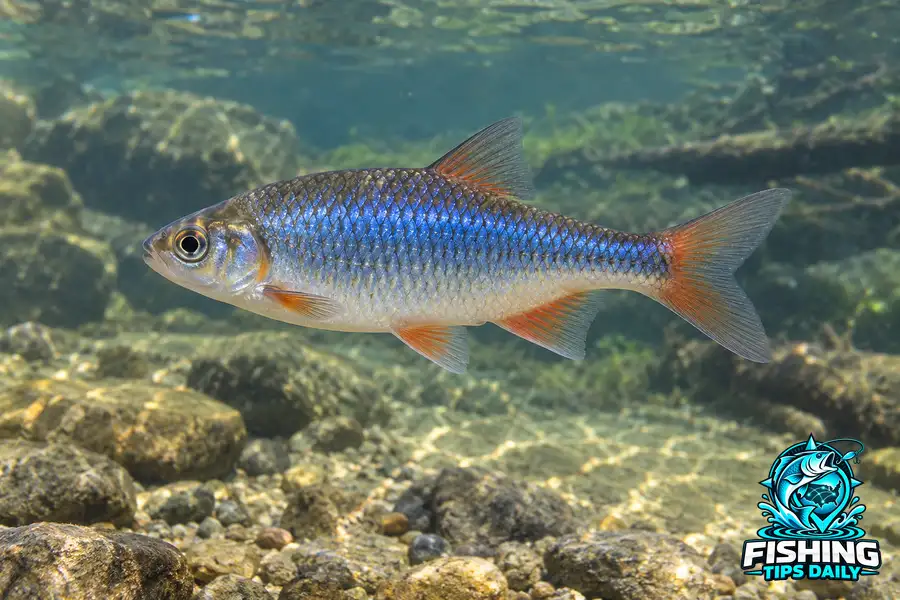
Identification
The narrow body has a small, triangular head. Breeding males become metallic blue with a blue-green side stripe, expanded dorsal fin and yellow or orange fins edged in white. Females and nonbreeding males are more subdued.
Size and Weight
The maximum reported total length is 10 cm, about 3.9 inches. An Alabama account describes adults more commonly at 5 to 7 cm, or 2 to 2.8 inches. A verified maximum individual body weight was not found. The upper length limit should not be interpreted as the size of most fish in a school.
Habitat and Natural Food
Clear pools with gentle current and sandy or gravelly bottoms are characteristic habitat. Terrestrial insects provide much of the food described in regional observations, along with immature aquatic insects. Its natural diet does not establish a recreational bait recommendation.
Spawning and Conservation
Eggs are placed in crevices, including those in submerged wood or bedrock. Conservation propagation has used this behavior to support recovery work. Remaining populations occupy a restricted portion of the Mobile basin, and the species is federally listed as threatened. This profile is intended for identification and understanding its habitat, not as an invitation to collect it.
Small Cracks Serve as Nurseries
Submerged wood and cracks in rock can provide the surfaces used for egg placement. The fish’s reproductive habitat therefore involves specific small spaces within a stream, not merely the presence of flowing water. Captive propagation work recreates suitable spawning crevices.
All Lakes With Blue Shiner
Browse lakes and reservoirs with documented Blue Shiner records, listed alphabetically. Records do not establish current abundance or public access. Check the evidence and managing authority for the water you choose.
No published lakes are currently linked to this species in our confirmed records.